
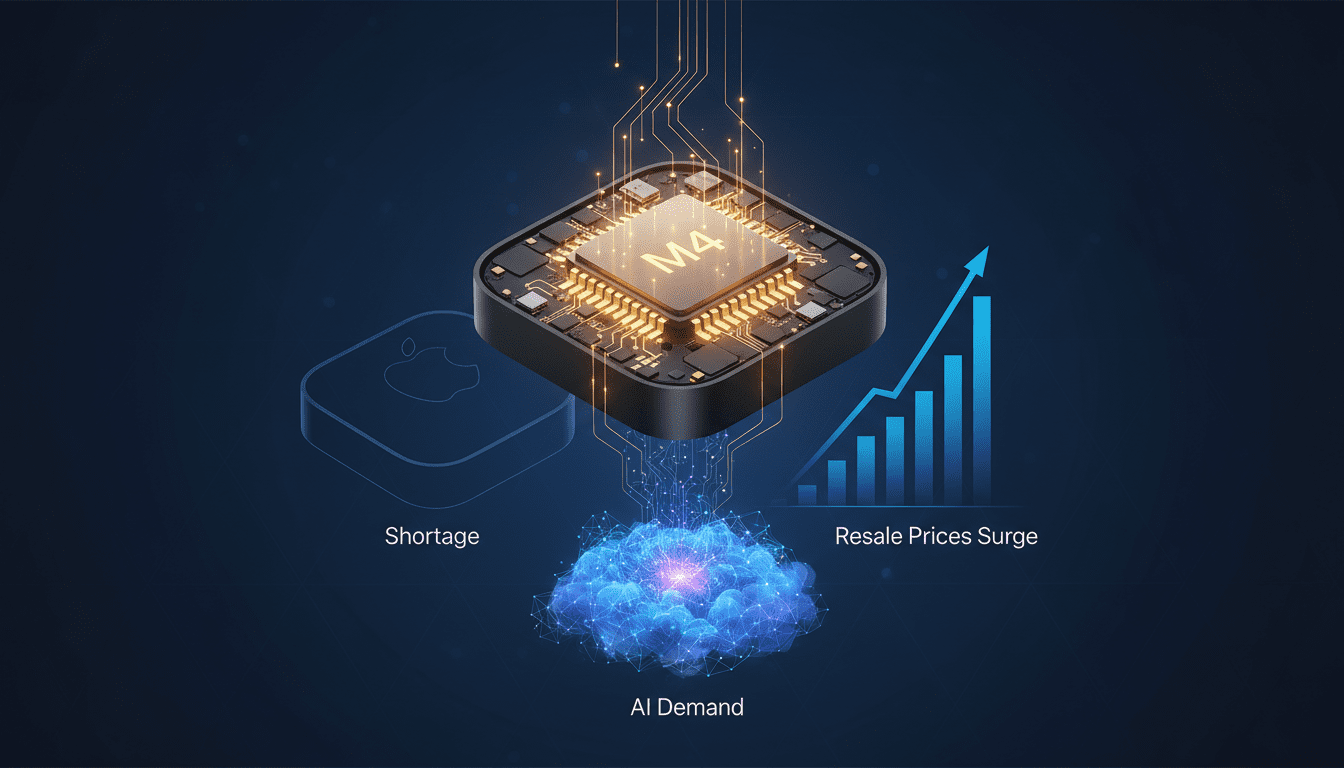
M4 Mac mini Shortage Turns $599 Entry Model into Above-Retail Resale Item as AI Demand Surges
M4 Mac mini shortages have emptied Apple’s store as AI-focused buyers turn the $599 base model into a high-demand resale item at above-retail prices now.
Why the M4 Mac mini suddenly matters to AI hobbyists and developers




Apple’s entry-level M4 Mac mini has shifted from being the company’s most affordable desktop to a scarce commodity sought by people running local AI models. The device’s combination of small footprint, energy efficiency, and enough compute to support experiments has made it a popular choice for developers and hobbyists testing models outside cloud environments. That practical fit — compactness, low noise, and modest power draw compared with larger workstations — is a central reason the base Mac mini has become attractive to anyone who wants an always-on machine for on-device AI work.
The interest is not purely hypothetical: specialized models and tools such as OpenClaw, ZeroClaw and Perplexity Computer have been named among those that draw users toward compact Macs for local experimentation. For buyers who prioritized an inexpensive Apple Silicon host for continual or frequent AI runs, the $599 base configuration represented the simplest on-ramp to local compute. Once Apple’s retail inventory for that configuration thinned, demand quickly migrated to secondary markets.
How resale listings reflect the shortage
With the base M4 Mac mini no longer available at Apple’s online store, resale sites — notably eBay — are showing a clear price premium. Reported listings include new “open box” units of the base configuration (16GB RAM, 256GB storage) priced roughly between $715 and $795. Refurbished examples have appeared at still higher tags, reportedly reaching about $979. Lightly used units are trading above the original sticker, with some listings around $700 and at least one brand-new listing climbing to $925 with seller claims of limited stock.
Those numbers make a consistent point: buyers who are willing to pay immediately for a compact Apple Silicon machine are often paying well above the factory price to avoid waiting for inventory to return. The resale premium is concentrated on the base model configuration most useful to cost-conscious AI experimenters, turning what was an entry-level machine into a higher-margin commodity for resellers.
Supply-side pressures identified by manufacturers and reporters
The shortage of the cheapest Mac mini configuration has not been attributed to a single cause in public reporting, but memory and NAND supply constraints have been cited as a contributing factor. Lower-cost Mac minis are more sensitive to shifts in DRAM and NAND availability because those components drive the price and shipping timelines for base configurations. When memory or storage components get tight, manufacturers often prioritize higher-margin SKUs or configurations with larger storage, leaving the least expensive models more likely to go out of stock.
At the same time, buyers who need machines quickly for local AI setups may be less willing to accept long shipping waits for higher-storage variants, which can take weeks to arrive. The resale market offers immediacy: sellers with stock can fill that need at a premium, a dynamic that has put upward pressure on used and open-box prices.
Why the Mac mini suits always-on local AI runs
Several practical device characteristics explain the Mac mini’s appeal for local AI tasks. Its compact chassis and desktop form factor allow it to be placed in small workspaces. Apple Silicon’s power efficiency helps it run long sessions without the power and thermal overhead of larger desktops, and the relative quiet of the design makes it easier to keep running in home or office environments. These attributes reduce the tradeoffs that typically accompany desktop-class hardware when used continuously for model inference or experimentation, which is why people testing smaller, specialized models have leaned on the Mac mini rather than bulkier, louder workstations.
The base configuration’s 16GB of RAM and 256GB of storage — the spec noted in resale listings — has proven sufficient for many local projects and lightweight model testing, further enhancing the base model’s appeal as a low-cost on-ramp.
Mac Studio and the rest of Apple’s desktop lineup under pressure
The scarcity effect is not limited to the Mac mini. Reporting indicates that Apple’s Mac Studio has also seen increased demand and sold-out configurations, altering availability across the desktop range. For buyers priced out of or shut out from the base Mac mini, the Mac Studio represents the next available desktop option, but it is a much larger step up in cost and capability than the $599 entry model. As long as the Mac mini remains scarce, some buyers seeking local compute capacity may either turn to higher-tier Apple desktops or wait for restocks, creating ripple effects across Apple’s product family.
There is also discussion in reporting about higher-end strategic shifts within Apple’s desktop lineup. Rumors of an “Ultra” tier above the Pro level suggest Apple may be aiming to expand its offerings at the top end of the market, a possible sign that Apple is refocusing product placement above its midrange Pro models. Those conversations, paired with the current shortages, illustrate how availability at one price point can skew demand up and across a product family.
How resellers are positioning immediate availability
Sellers on resale platforms are leveraging the gap between demand and Apple’s in-store supply by offering immediate availability. Listings at-premium prices frequently emphasize prompt shipping and “last one” inventory messages, addressing a buyer need Apple’s online storefront cannot meet when configurations are sold out. For buyers who are setting up AI hardware and do not want to wait for factory restocks or weeks-long shipping for alternative configurations, the resale market becomes an expedient — if more expensive — path.
This dynamic reflects a classic arbitrage: limited supply at retail, growing specific demand (in this case for local AI use), and a secondary market willing to bridge the two for a fee. The resale premium appears most pronounced for the lowest-cost Mac mini configuration, the model that historically served as the most accessible entry point for price-sensitive developers and hobbyists.
What this shortage means for developers and small teams
For individual developers, makers, and small teams experimenting with local AI, the shortage complicates plans that relied on an affordable Apple Silicon desktop. The base Mac mini’s scarcity raises the effective cost of acquiring an on-device development environment; developers who cannot or will not pay resale premiums must either wait for Apple restocks, choose a higher-priced Apple desktop, or look to non-Apple alternatives.
The situation also affects development workflows and hardware planning. Projects that assumed ready access to an inexpensive, quiet, always-on Mac for model testing may experience delays or higher hardware budgets. Organizations that prioritize local compute for data privacy, latency, or offline use cases will face the same constraints when Apple’s entry-level offering is unavailable.
Broader implications for the hardware and retail ecosystem
The interplay between component supply, buyer demand driven by new use cases, and secondary markets highlights how shifts in software trends — in this case, the migration of certain AI tasks toward local execution — can quickly stress hardware availability. Memory and NAND supply issues alter how manufacturers allocate inventory across configurations; when a specific configuration becomes strategic for a new use case, that mismatch can produce outsized effects on pricing and availability across channels.
For retailers and Apple itself, the shortage illustrates the sensitivity of product lines to sudden, use-case–driven demand spikes. For the resale ecosystem, it underscores how short-term scarcity creates opportunities for margin capture, particularly when sellers can provide immediate fulfillment of a narrowly defined need.
What buyers considering a local AI setup should know
Buyers eyeing a Mac mini specifically for on-device AI experiments should weigh several practical points reflected in recent market behavior. First, the base M4 Mac mini configuration that has been commonly used for local AI is hard to find at the original $599 price, and comparable listings on resale platforms have carried premiums commonly in the low hundreds of dollars. Second, configurations with more storage or different specs may be available from Apple but can have longer lead times; buyers unwilling to wait may find themselves paying above retail. Third, Mac Studio and other higher-tier desktops may be available but represent a significant cost increase relative to the base Mac mini.
Those considerations make the current market one of tradeoffs between price, immediacy, and desired capability: pay a premium now on the resale market, accept shipping delays for new Apple orders, or benchmark alternatives outside Apple’s ecosystem.
How this development fits into ongoing industry trends
The Mac mini shortage is an example of a larger pattern in which evolving software demands — here, interest in local AI experimentation — cause rapid, localized strain on specific hardware SKUs. It also shows how supply-chain frictions (memory and NAND constraints) interact with demand-side changes to create visible market distortions. In parallel, the reported interest in higher-end Apple desktops and rumors of an “Ultra” tier reflect manufacturer-side responses that can reshape product segmentation over time.
For adjacent ecosystems — developer tools, AI frameworks, and productivity or automation platforms that target on-device workflows — constrained access to widely accessible hardware could slow adoption among smaller teams or hobbyists, while enterprise users or well-funded developers continue to access capacity through cloud or higher-end desktops.
The situation naturally invites attention from companies that build tools targeting local inference, on-device model deployment, or developer tooling for Apple Silicon, since their addressable audience may be temporarily limited by hardware availability.
The broader picture also touches on resale markets and their influence on consumer experience: when a practical hardware configuration disappears from retail, secondary channels can absorb demand but at the cost of higher prices and unequal access.
Despite these pressures, the Mac mini’s popularity for local AI work underscores an important trend: demand for compact, efficient systems capable of running specialized models locally is real and translating into concrete purchasing behavior.
A look ahead
If Apple replenishes the base Mac mini configuration, resale premiums would likely ease and the on-ramp for local AI experimentation would reopen at its prior price point; conversely, prolonged component constraints or sustained interest from AI users could keep upward pressure on the secondary market. Meanwhile, demand that has migrated toward the Mac Studio and discussion of a potential Ultra-class product suggest Apple’s desktop strategy and inventory priorities will remain an important factor for users weighing local compute options. For developers, organizations, and hardware vendors, the episode is a reminder that emerging software use cases can rapidly revalue specific hardware configurations, shifting purchasing patterns and opening opportunities — and headaches — across retail, resale, and supply-chain chains.