
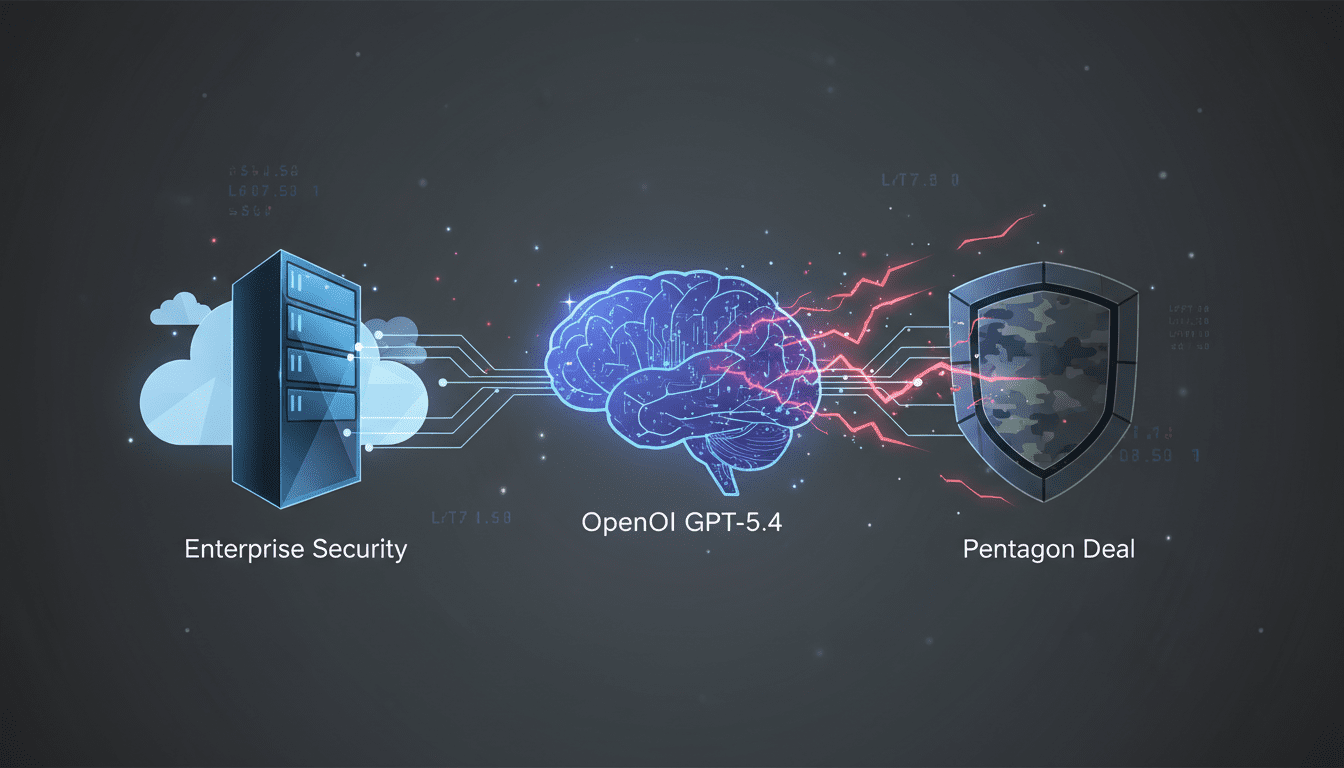
GPT-5.4 Brings Desktop Navigation, Tool Search and an Excel Add-in — What It Means for Automation, Security, and the Enterprise
GPT-5.4 brings desktop navigation, Tool Search token savings, and a ChatGPT Excel add-in to speed automation and reasoning for developers and enterprise users.
A stronger generalist for hands-on automation




OpenAI’s GPT-5.4 arrives as a capability-focused update intended to move large language models beyond text generation toward reliable, multi-step automation and situated reasoning. The release, offered in Thinking and Pro variants, is designed to interpret screenshots, interact with user interfaces, and coordinate workflows across applications — tasks that shift an LLM from an assistant that advises to one that can act. Those who build developer tools, enterprise automation, or knowledge-worker workflows will want to understand not just what GPT-5.4 can do, but the trade-offs it introduces in cost, safety, and integration complexity.
What GPT-5.4 delivers
GPT-5.4’s headline features are practical: improved desktop navigation accuracy, a new Tool Search mechanism that reduces token consumption, and a ChatGPT Excel add-in that embeds reasoning and automation into spreadsheets. According to early benchmarks, the model reaches high success rates on desktop navigation tasks, making it possible for agents to complete actions like clicking buttons or extracting information from graphical interfaces with a repeatable, measurable success profile. Tool Search is pitched as a cost and performance optimization that reduces token use nearly in half for certain workflows, and the Excel add-in aims to bring generative and procedural intelligence to a widely used productivity surface.
The model is available via the ChatGPT product and API, and OpenAI has positioned it as part of a broader stack that includes iterative updates to the default models powering chat experiences.
How Tool Search and token efficiency work
Tool Search is a new mechanism that narrows the model’s interaction footprint with external tools and APIs by selecting the smallest, most relevant set of tool invocations to accomplish a task. In practice, that means fewer tokens are spent describing context or invoking tool metadata; early reports cite roughly a 47% reduction in token usage in targeted scenarios. For organizations that run high-volume programmatic calls, token efficiency translates into lower variable costs and faster loop times. The trade-off is a dependence on accurate tool metadata and robust orchestration logic: if Tool Search chooses the wrong tool or context, the model must either recover gracefully or defer, which adds implementation complexity.
From an integration perspective, Tool Search favors modular tool stacks and explicit, well-documented APIs. Teams that want to maximize the savings should focus on designing compact tool interfaces, clear type signatures, and reliable error semantics so the model can make confident choices with fewer tokens.
Desktop navigation, automation, and the Excel add-in
One of GPT-5.4’s more consequential capabilities is its ability to interpret screenshots and manipulate desktop UIs. Benchmarks show a significant improvement in completing navigation tasks end-to-end — a capability that turns agents into semi-autonomous operators for repetitive workflows like data entry, application testing, or multi-step report generation. For enterprises, that opens new opportunities to automate across legacy systems that lack APIs or are otherwise brittle to integrate.
The ChatGPT Excel add-in packages natural language reasoning and automation directly inside spreadsheets. Users can ask the model to analyze tables, build formulas, summarize trends, or generate multi-step macros that combine spreadsheet operations with external data calls. For analysts and financial teams, that reduces friction between insight generation and execution. For IT and platform teams, it introduces a new integration surface that must be governed: access controls, audit logs, and careful prompt design become part of spreadsheet governance.
Organizations planning to adopt these features should focus on secure deployment patterns — including tenant isolation, role-based access controls, and monitoring of automated actions — because adding “actuation” to a conversational model raises both productivity and risk.
Speed and safety: the role of GPT-5.3 Instant
GPT-5.4 arrives in a landscape where model cadence is accelerating. OpenAI recently promoted GPT-5.3 Instant as the default ChatGPT model; that intermediate update prioritized latency, reduced hallucination rates by notable percentages, and trimmed verbose preambles. These faster, lower-hallucination models reduce friction for interactive use and for tightly looped automation where prompt latency matters.
The ecosystem is now layered: instantaneous interaction models for chat, capability-oriented models like GPT-5.4 for automation, and specialized variants for safety-constrained or compliance-sensitive deployments. Teams should choose the model aligned with their primary need — conversational speed, deterministic automation, or heavily audited inference — and be prepared to route requests across endpoints rather than rely on a single all-purpose model.
Where GPT-5.4 fits in the broader AI ecosystem
GPT-5.4’s advances arrive amid intensifying competition and complementary product moves. Google is doubling down on integrated workspaces with Canvas in AI Mode, which adds project-centric panels and Gemini-powered in-search editing capabilities. Microsoft continues to fold advanced assistants into Copilot experiences, previewing multi-step task automation for business users. Anthropic, smaller LLM vendors, and niche AI workbench providers are responding with their own reasoning and safety features.
For enterprises, the choice increasingly becomes less about raw model capability and more about systems integration, governance, and long-term platform strategy. Organizations must weigh on-premises and on-device options — particularly as Apple and other hardware vendors push stronger on-device AI features — against cloud-based models that deliver the fastest innovation but demand tighter operational controls.
The Pentagon deal and governance implications
Recent procurement developments have also changed the political and governance context for enterprise AI. The Pentagon’s selection of OpenAI for certain classified system work, replacing previous providers, underscores a growing expectation that federal and defense customers will demand both technical capability and strict policy guardrails. The contract reportedly includes explicit limitations on surveillance and autonomous weapons, even as critics warn about broad permissive language like “all lawful purposes.”
For civilian enterprises and vendors, this shift signals an era where government requirements will increasingly shape certification, security posture, and auditability expectations. Companies aiming to serve regulated sectors should build governance primitives — provenance metadata, explainability logs, red-team results, and compliance workflows — that mirror the rigor being demanded by federal contracts.
Developer implications and integration patterns
For developers, GPT-5.4 is not just a new model but a nudge toward new integration patterns. Practical considerations include:
- Designing compact, deterministic tool APIs so Tool Search can pick them confidently.
- Building robust error handling and fallback strategies for navigation tasks that interact with unreliable UI elements.
- Instrumenting every automated action with auditable logs and human-in-the-loop checkpoints.
- Creating prompt templates and conversation state machines that can survive model restarts or context window limits.
- Evaluating token economics: the $2.50 per million input tokens pricing for certain usage tiers changes the ROI calculus for high-throughput automation.
These patterns are immediate priorities for platform engineers and product teams planning to add agentic capabilities to software suites, internal tooling, or customer-facing automation.
Security, privacy and emerging threat vectors
As models gain the ability to act, security surfaces expand. Several contemporaneous incidents illustrate the stakes: legacy-data breaches, supply-chain leaks, and vulnerabilities that let crafted prompts escalate to remote code execution have all surfaced in recent reporting. Notable categories of risk include:
- Prompt-enabled exploits: vulnerabilities that allow malicious inputs to drive unsafe operations or exfiltrate secrets.
- Credential leakage: exposed API keys and secrets can grant unauthorized model access to downstream systems.
- Device-level privacy issues: integrations that transmit audio, images, or sensor data to third parties can create GDPR and privacy exposures.
- Signed-driver abuse and kernel-level techniques: attackers can subvert trusted components to disable endpoint protections, complicating detection of automated misuse.
Mitigation strategies for teams adopting GPT-5.4 should include strict key management practices, input sanitization, sandboxed execution environments for agent actions, least-privilege service accounts for automation tasks, and continuous red-teaming to probe both prompt and tool-level defenses.
Platform reactions: Google, Microsoft, Apple and beyond
Platform vendors are responding to the rapidly evolving AI capability set. Google’s Canvas in AI Mode and Gemini integration target fluid document-to-code-to-dashboard workflows that rival the agentic approach by keeping interactions within a unified workspace. Microsoft’s Copilot evolution, including multi-step Copilot Tasks, aims to operationalize complex business processes from within productivity apps. Apple’s hardware announcements — notably laptops with on-device intelligence and new mobile features that emphasize local AI — highlight a divergent strategy: migrate certain AI workloads to the device for latency, privacy, and power-efficiency benefits.
For enterprises, the practical outcome is hybridization: some inference and stateful automation will live on-device, some in private cloud enclaves, and some in public cloud APIs. This hybrid posture requires consistent identity, telemetry, and policy layers across execution environments.
Business shifts and workforce impacts
The accelerating replacement of manual tasks with agentic automation has already influenced corporate planning. Several firms are re-evaluating headcount and operating models as they deploy AI-driven automation to reduce costs and accelerate delivery. Major infrastructure investments — including multi-billion-dollar data center expansions — are incentivizing cost control moves like workforce reductions and reorganizations.
At the same time, acquisition and restructuring activity in media, telecom and enterprise software continues, reshaping partnership and procurement landscapes. These market shifts affect how organizations prioritize AI projects, choose vendors, and budget for compliance, security, and change management.
Practical guidance: who should consider GPT-5.4 and when
GPT-5.4 is most compelling for organizations with clear, repeatable workflows that benefit from UI-level automation, for teams that need advanced reasoning embedded into productivity surfaces, and for vendors building horizontal automation platforms. Specific scenarios include:
- Enterprises with legacy, GUI-only systems that need automation without invasive engineering effort.
- Analytics and finance teams who want to automate multi-step spreadsheet workflows and integrate narrative insights with execution.
- ISVs that plan to offer agentic features inside SaaS products and need a managed model with accessible tooling.
- Security teams looking to prototype automated incident-response playbooks that interact with consoles and dashboards.
Conversely, organizations should delay adoption if they lack strong governance tooling, robust secret management, or the capacity to instrument and monitor automated actions. Early pilots should be limited in scope, include human oversight, and prioritize safety-critical mitigations such as allowlists, sandboxing, and immutable logging.
Monitoring adoption, costs, and downstream effects
Adopting GPT-5.4 implicates both technical debt and operational cost. Token-based pricing requires careful measurement of typical prompt sizes, expected agent decision paths, and frequency of automated actions. Tool Search reduces token counts, but optimizing tool design to realize those savings takes engineering work. Monitoring, observability, and anomaly detection become central: teams must track both model outputs and the real-world effects of those outputs to identify drift, failures, or adversarial exploitation.
Business teams also need to set expectations: agentic automation will reduce some manual labor but will increase demand for oversight roles, prompt engineering, SRE-style ownership, and legal/compliance review.
What to watch next
Over the coming months, adoption patterns, regulatory responses, and security research will determine how agentic models are bound into enterprise workflows. Key signals to monitor include:
- Real-world reliability metrics for desktop navigation across heterogeneous environments.
- Reports on misbehavior and error modes when agents operate on production systems.
- Vendor roadmaps for on-device vs. cloud execution and how those affect latency, privacy, and compliance.
- Regulatory moves and federal contracting language that shape what use cases are permissible for defense and critical infrastructure.
- Security disclosures that either expose new attack surfaces or highlight mitigations for prompt-enabled vulnerabilities.
Teams that track these signals can adapt roadmaps, prioritize controls, and choose partnerships that align with their risk appetite.
Integrations, tooling, and internal-signal phrases for further reading
As organizations explore GPT-5.4, natural internal link targets in documentation and knowledge bases include: enterprise AI strategy, developer tools, automation platforms, on-device AI, Copilot integrations, and security hardening for LLMs. Cross-functional documentation that connects product requirements, security checklists, and engineering patterns will accelerate safe adoption.
Capability and caution
GPT-5.4 marks an incremental but meaningful step toward models that not only reason but act. That evolution opens practical gains in automation and productivity while increasing the imperative for robust governance, secure integration practices, and thorough testing. Organizations that pair capability pilots with disciplined safety engineering and cost controls are best positioned to capture value without exposing themselves to unacceptable risk. The broader industry — from cloud providers to hardware vendors and regulators — is rapidly aligning to support, constrain, and compete with agentic AI; the next year will show which architectures and policies create durable, responsible deployments.