
Coco 2 and Niantic Spatial Bring Autonomous Delivery Robots onto Streets and Bike Lanes
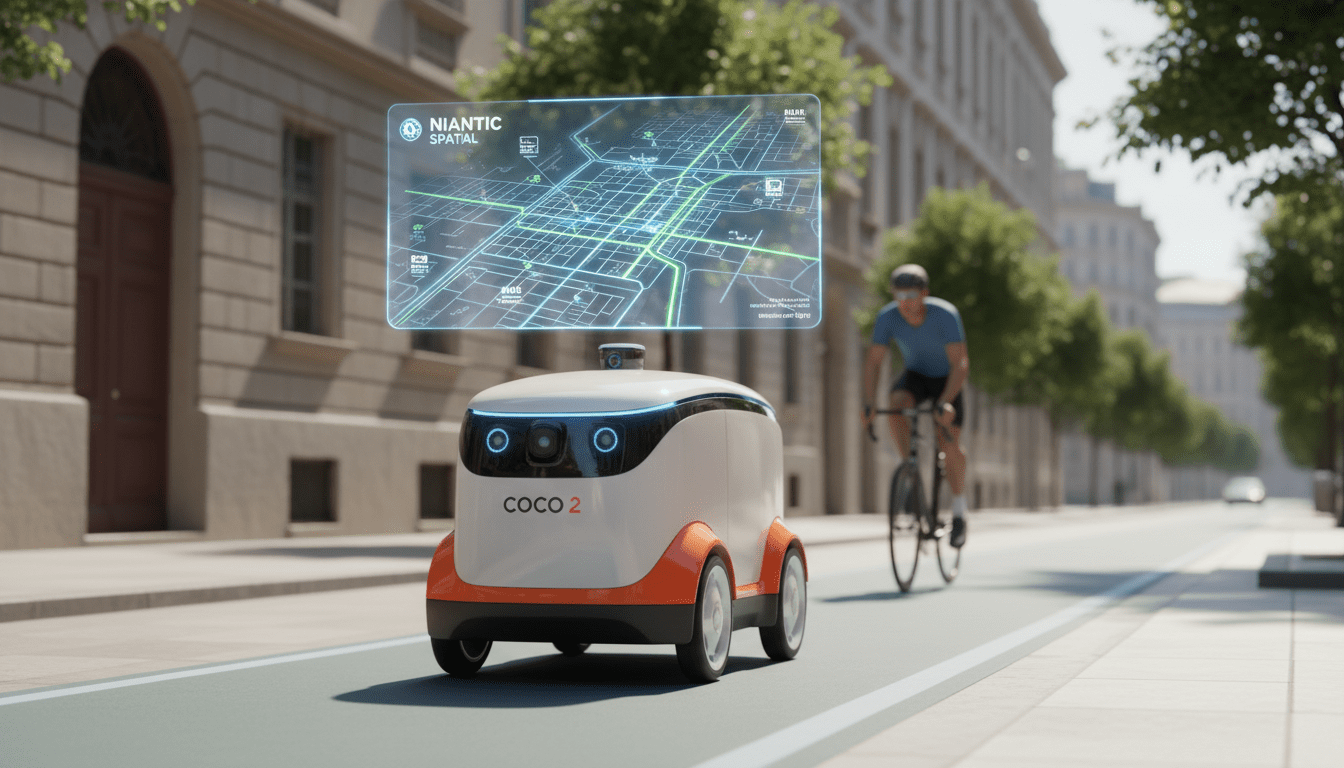
Coco 2 pairs Coco Robotics’ next‑gen delivery robot with Niantic Spatial visual positioning to enable autonomous street and bike‑lane deliveries at up to 13 mph.
Coco 2, Coco Robotics’ next-generation autonomous delivery robot, is taking the category beyond curbside novelty into higher-speed, street-capable operations — a shift with implications for city logistics, regulation, and the developer ecosystems that support robotic navigation. As an autonomous delivery robot designed to operate without remote human drivers and to use streets and bike lanes where permitted, Coco 2 leverages a visual positioning stack from Niantic Spatial to solve the thorny localization and routing problems that satellite GPS alone can’t reliably handle in dense urban environments.




Why Coco 2 Matters for Urban Logistics
Delivery robots have so far been constrained by cautious design choices: low speeds, sidewalk-only operation, and frequent human oversight. Coco 2 signals an evolution in ambition and capability. By raising top speeds to as much as 13 mph and enabling lawful operation on streets and bike lanes, the platform aims to increase throughput and reduce trip times — both vital to making micro-delivery economically viable at scale. The move also reframes the robot from a last‑meter novelty to a potential urban logistics workhorse capable of carrying multiple orders on a single run.
This change matters because it alters how businesses think about last-mile architecture. Faster, street-capable robots can bridge gaps between micro-fulfillment centers and customers more efficiently than slower sidewalk bots or costly human couriers. If adopted broadly, they could reshape delivery windows, reduce the need for large centralized warehouses inside dense cores, and create new integration points with point-of-sale systems, order management platforms, and routing services.
How Niantic Spatial’s Visual Positioning System Enables Accurate Urban Navigation
A central technological hurdle for urban autonomy is precise localization. In city canyons with tall buildings, GPS signals degrade and multipath effects produce drift measured in meters rather than the centimeters an autonomous system needs for safe drop-offs. Niantic Spatial’s visual positioning approach uses a large corpus of geotagged imagery and machine learning to match what the robot sees to a detailed visual map of the environment, producing a much tighter estimate of where the vehicle is relative to sidewalks, curbs, entrances, and loading zones.
By fusing visual cues with other sensor inputs — lidar, stereo cameras, IMUs — the stack reduces reliance on satellite positioning for tasks that require pinpoint accuracy, like stopping on the correct side of the street or aligning with a specific building entrance. The mapping foundation Niantic built for augmented-reality experiences is being repurposed for physical navigation: posed images from millions of locations create a visual database that helps machines determine where they are when GPS alone can’t be trusted.
Technical Challenges of Operating Off the Sidewalk
Operating in streets and bike lanes exposes robots to a different risk profile than sidewalk delivery. Streets introduce faster-moving vehicles, complex right-of-way rules, and interactions with cyclists who may weave unpredictably. Bike lanes present similar safety dynamics while also narrowing the margin for maneuver. To meet those conditions, Coco 2 must marry robust perception with conservative behavioral planning.
Perception needs to detect and classify diverse road actors — motor vehicles, cyclists, pedestrians, and static infrastructure such as parked cars and construction barriers — at various speeds and lighting conditions. The planning layer translates those detections into safe trajectories, accounting for local traffic laws and social norms. Redundancy is essential: multiple sensor modalities and fallback behaviors reduce the chance that a single sensor failure leads to unsafe action.
Beyond sensors and software, system validation and simulation play a heavy role. Training across edge cases — sudden weather changes, reflective surfaces, dense traffic — and running millions of simulated miles to explore rare events are standard parts of pushing autonomy into more complex domains.
Operational Performance and Real-World Testing
Coco Robotics reports substantive operational experience: hundreds of thousands of completed deliveries and a fleet presence in multiple markets across the United States and Europe. Those real-world miles are indispensable for tuning perception, policy, and logistics. Coco 2’s training reportedly accounted for extremes — flooding-prone routes, freezing winters, and congested corridors — which helps the robots learn to handle conditions from standing water to icy surfaces and dense slow-moving traffic.
Multi-order carrying capability is another practical design choice. Packing several customer orders on one trip reduces per-order cost and improves utilization, but it adds complexity around routing, secure compartments, and last‑meter handoff. To be commercially useful, the robot’s delivery flow must balance efficiency with customer expectations for accuracy and timeliness.
Regulatory and Urban Infrastructure Hurdles
Technical capability is only one side of the equation. Whether cities will allow street and bike‑lane operation depends on local regulations, safety proofs, insurance frameworks, and public acceptance. Some municipalities explicitly limit autonomous robots to sidewalks or prohibit them from entering traffic lanes; others are experimenting with pilot programs that permit broader operation under defined conditions.
Regulators will want to see evidence of safe interaction patterns with cyclists and drivers, clear liability models, and transparent data practices. Infrastructure also influences outcomes: cities with protected bike lanes, well-marked loading zones, and consistent curb management are more robot-friendly. Conversely, areas with ad hoc parking, ambiguous curb rules, and fragmented enforcement complicate deployment.
Public communication and coordination with planning departments, police, and transit agencies often make the difference between a scaled rollout and a stalled pilot. Demonstrating how robots manage curb access, avoid blocking pedestrian flows, and respond to unusual road events will be crucial to winning long-term permission for street-level operation.
Who Can Use Coco 2 and Which Use Cases Fit Best
Coco 2’s design targets businesses that need frequent, short-range deliveries in dense urban neighborhoods: restaurants and cloud kitchens offering rapid food service, grocery and convenience chains enabling same-hour fulfillment, pharmacies for urgent prescriptions, and retailers for small-item ecommerce. Micro-fulfillment centers or dark stores can serve as satellite nodes that feed the robots for quick dispatch.
Enterprises with existing order-management systems, POS integration needs, or subscription-based delivery models can integrate robot fleets to reduce human courier costs and provide predictable delivery times. The approach also opens opportunities for partnerships with logistics platforms, dispatch providers, or last-mile orchestration tools that can schedule, batch, and track robot runs across neighborhoods.
At the consumer level, the experience must be seamless: reliable ETAs, easy authentication for order release, and clear fallback procedures. Businesses experimenting with robot delivery should prioritize areas with good pedestrian and cycling infrastructure, predictable demand patterns, and favorable municipal policies.
Developer and Ecosystem Implications
Coco 2’s reliance on a visual positioning stack highlights a broader shift: navigation and autonomy are becoming more tightly coupled to rich geospatial datasets and developer-facing mapping APIs. That expands the role of developer tools that manage map content, versioning, and privacy-preserving telemetry from vehicles. Robotics developers, mapping providers, and platform operators will need to agree on standards for map updates, edge-case data collection, and anonymization of imagery used for training.
Integration opportunities exist across AI tools (for perception and predictive routing), automation platforms (for dispatch orchestration), CRM systems (for customer communication), and security software (for endpoint and fleet protection). For developers building complementary services — such as route optimization, dynamic pricing, or inventory synchronization — robot fleets present a predictable, programmable delivery endpoint that can be tied into larger fulfillment flows.
Security and data governance will grow in importance. Visual positioning systems depend on large visual datasets; ensuring that collection and use of imagery comply with privacy expectations is a nontrivial task. Similarly, fleet security requires defending against GPS spoofing, sensor tampering, and network-level attacks targeting telemetry channels.
Business Considerations and Cost Structure
Deploying street-capable robots changes the cost calculus. Higher speeds and multi-order capacities increase revenue potential per trip but also raise hardware, software, and insurance expenses. Companies must weigh capital investment in robots and back-end systems against expected reductions in human labor and vehicle miles traveled.
Operational costs include fleet maintenance, battery management, remote monitoring, and local operations teams for handling exceptions and charging infrastructure. There is also a sales and regulation cost: time spent obtaining permits, negotiating pilot agreements, and engaging the public. For enterprise buyers, total cost of ownership depends on utilization rates, average trip length, urban density, and the ability to cluster deliveries effectively.
Broader Industry Impact and Competitive Landscape
Coco 2’s street-capable push is part of a larger trend toward more capable, persistent autonomous systems operating in public spaces. Larger logistics players and startups alike have experimented with sidewalk robots, drones, and human-driven micro-mobility to solve last-mile frictions. If Coco 2 and its counterparts prove safe and economical, we may see a market bifurcation: simple sidewalk robots for low-risk neighborhoods and higher-capability platforms that operate in mixed traffic corridors, offering faster service tiers.
Competition will likely come from a mix of incumbent logistics firms retrofitting existing fleets, startups focused on niche environments, and technology companies offering mapping and autonomy stacks. Partnerships—like the one between Coco Robotics and Niantic Spatial—illustrate a model where navigation expertise and robotics hardware combine to accelerate readiness. That approach can speed technical progress but also raises questions about dependence on third-party mapping datasets and interoperability across platforms.
Practical Questions: What the Robot Does, How It Works, and When It Can Be Used
Coco 2 performs point-to-point deliveries in urban areas, carrying multiple customer orders per trip and relying on a combination of sensors and visual mapping to localize and navigate. In deployment, it follows preplanned routes from distribution nodes to customer addresses and uses visual cues to precisely position for drop-offs. The system’s autonomy stack handles perception, path planning, and decision-making; a fleet management layer orchestrates dispatch and customer communication.
How it works in practice: the robot fuses lidar or stereo imagery with Niantic Spatial’s visual map data to correct GPS drift, then executes safe trajectories that respect traffic rules and dynamic obstacles. When encountering an unexpected scenario—construction, blocked curb, or an aggressive cyclist—the robot either replans locally or triggers an operator intervention if needed, though the design intent is to minimize teleoperation.
Who can use it: merchants, delivery platforms, and logistics providers serving dense urban neighborhoods with regulated, robot-permissive street or bike-lane infrastructure. When it will be available: exact availability is market-dependent, governed by local pilot approvals and business rollouts; operators typically begin with limited-scope pilots before scaling service areas.
Safety, Public Perception, and the Path to Acceptance
Safety is the precondition for acceptance. Demonstrations and data showing low incident rates, predictable behavior around vulnerable road users, and transparent escalation protocols will influence public opinion and municipal policy. Outreach programs that explain how robots yield to pedestrians, avoid obstructing sidewalks, and follow local loading rules help normalize their presence.
Public perception also hinges on visible benefits: reduced delivery vehicle clutter, lower emissions if robots are electric, and more reliable delivery windows. Conversely, incidents, even minor, can prompt rapid regulatory backlash. Operators must therefore prioritize conservative safety envelopes over marginal efficiency gains.
Coco 2’s operators will need to maintain clear channels for community feedback and rapid response teams to address problems and improve behavior through iterative software updates. Trust grows when systems demonstrate predictable, polite interactions with people and other road users.
Coco 2 and Niantic Spatial’s collaboration signals a pragmatic approach to urban autonomy: marry advanced mapping and localization with tested vehicle platforms and real-world operations to push capabilities forward while collecting the lengthy, expensive datasets that make safe scaling possible.
Looking ahead, the industry is likely to see continued specialization — mapping providers focusing on visual localization services, robot makers optimizing form factors for different delivery types, and software companies offering orchestration layers that sit between merchants and fleets. As robots gain experience and municipal frameworks adapt, expect new service models (e.g., scheduled neighborhood rounds, micro-hubs, and hybrid human-robot handoffs) to emerge, reshaping how goods move inside cities.