Nuro Driver Tests Zero‑Shot Autonomy in Tokyo to Measure Cross‑Market Portability
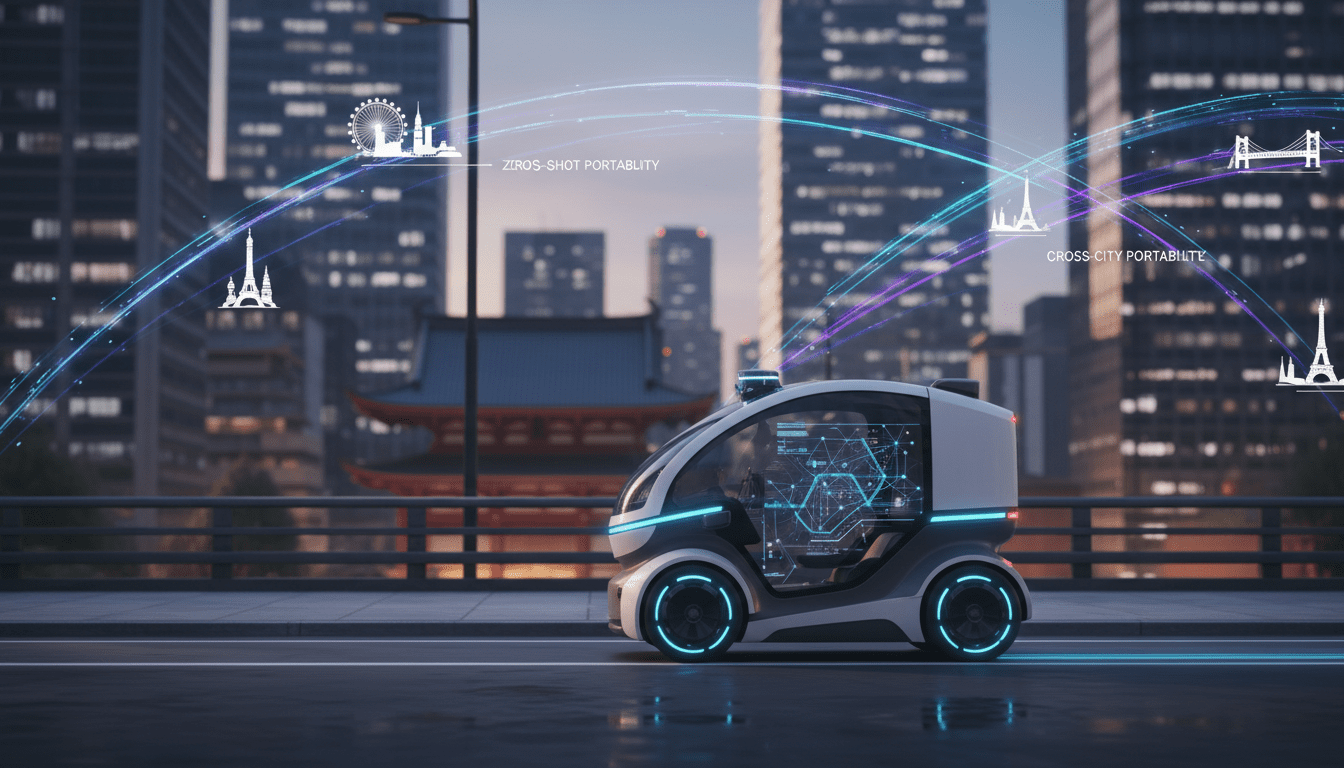
Nuro Driver’s Tokyo trials put zero-shot autonomy to the test, assessing whether a single driving model can adapt to dense, unfamiliar urban streets without bespoke, city-by-city rewrites.
Nuro Driver’s Tokyo rollout and why it matters




Nuro has begun public-road testing of the Nuro Driver in Tokyo, marking the company’s first deployment outside the United States and one of the earliest real-world experiments labeled as “zero-shot autonomy.” The phrase signals an intention to run the same core model in a new city without rebuilding maps, rewriting rules, or performing exhaustive local retraining. That ambition matters because the biggest barriers to scaling autonomous systems aren’t purely technical capability in one place — they’re the cost, time, and complexity of adapting software to each market’s traffic patterns, signage, and regulatory landscape. Tokyo’s tight streets, dense traffic, and local driving conventions make it an intentionally demanding proving ground for any system claiming broad portability.
Why Tokyo presents a rigorous test for autonomous models
Tokyo is a distinctive environment for autonomous vehicles. Its road network combines narrow laneways, multi-lane arterials, and a heavy mix of pedestrians, cyclists, and micro-mobility. Signage and lane markings can differ from those in North America, and local driving behavior — from yielding norms to parking patterns — reflects cultural and regulatory conventions. These factors create a concentration of “edge cases” that reveal whether an autonomy stack genuinely generalizes or simply overfits to the environment where it was trained. By testing the Nuro Driver in Tokyo, the company is confronting differences in sensor reflections, signage language, traffic signal timing, and human behavior that often break systems optimized for a single market.
What zero‑shot autonomy seeks to prove and why it’s ambitious
Zero-shot autonomy, in the way Nuro frames it, is the capacity for a single driving model to function safely and effectively in a new geographic area without city-specific policy rewrites or a full local retraining cycle. Demonstrating this would reduce the operational friction of geographic expansion: less manual mapping, fewer weeks of local data collection, and faster business rollouts.
But the ambition is high. Real-world driving involves long tails of rare events — unusual weather, irregular signage placements, informal traffic control, and unpredictable human actions. A zero-shot approach must combine broad situational understanding, robust perception across sensor modalities, and decision-making that generalizes to those rare situations. The Tokyo trial doesn’t declare victory for global autonomy; it’s a stress test that can expose where generalization holds and where targeted tuning remains necessary.
How Nuro Driver is built and validated
Nuro has evolved beyond small delivery robots into a licensing business for the Nuro Driver autonomy stack, offering its software to automakers and mobility partners. The technical strategy behind Nuro Driver synthesizes several elements common to advanced autonomy efforts:
-
Simulation-first training: Large-scale virtual environments allow the team to expose models to an enormous variety of synthetic scenarios, including rare and dangerous events that are impractical to stage in the real world.
-
Closed-course validation: Before public roads, the stack is exercised in controlled facilities where specific interactions and failure modes can be provoked and measured.
- Real-world trials: Actual street deployments provide the final arbiter for how perception and planning perform amid sensor noise, weather variability, and human unpredictability.
Nuro reports that its system is trained and validated via these complementary methods. In principle, simulation and closed-course work help a model learn generalized behaviors, while targeted on-road data fine-tunes performance against the unexpected realities of live traffic. The Tokyo deployment is a key element of that final validation loop: it reveals gaps that simulation and domestic trials may not surface.
Operational design: sensors, mapping, and domain adaptation
Successfully operating in a new market typically requires a stack that handles three technical challenges: accurate perception in a new visual environment, localizing without high-definition pre-built maps, and making decisions consistent with local traffic norms.
Nuro Driver’s architecture leans on multimodal perception (camera, lidar, radar) fused with machine learning models trained to perceive and classify objects across a variety of scenes. Domain adaptation techniques — methods that help models transfer learned features from one environment to another — are central to any zero-shot claim. These techniques include sensor normalization, augmentation strategies that mimic local visual artifacts, and meta-learning approaches that teach models to adapt quickly with minimal local data.
Mapping strategies matter, too. A zero-shot approach reduces reliance on bespoke HD maps by combining coarse map priors with robust localization from visual and lidar cues. If the stack can navigate using lightweight map inputs and strong scene understanding, it can avoid the labor-intensive process of building rich maps for each city.
Business model and strategic partnerships shaping the rollout
Nuro’s shift from autonomous delivery robots to licensing the Nuro Driver to automakers and mobility partners positions the company as both technology vendor and integrator. Its recent financing rounds attracted strategic investors, signaling that partnerships are central to scaling. Collaborations with mobility platforms and vehicle makers create distribution channels while also exposing the software to broader vehicle platforms and operational domains.
Testing in Tokyo under partnerships with local or global mobility players accomplishes multiple goals: it provides a commercial proof point, helps cultivate regulatory relationships in a major market, and demonstrates to potential partners that the stack can operate beyond its initial geography. For the industry, this model—selling an autonomy stack rather than vehicles—creates a vendor ecosystem where automakers, fleet operators, and software providers each play distinct roles.
Limits and safety considerations in cross‑market expansion
Even if a model performs well in Tokyo’s streets, several constraints and risks remain before declaring a generalizable solution:
-
Regulatory diversity: Road laws, liability frameworks, and certification requirements vary widely. Passing a technical test does not automatically translate to regulatory approval.
-
Edge‑case multiplication: Every new city introduces unique edge cases — seasonal weather patterns, construction practices, and atypical traffic controls — that can create new failure modes.
-
Sensor and infrastructure mismatch: Differences in lighting, reflective materials, and roadside infrastructure can change sensor performance. Localized electromagnetic interference or different signage materials might degrade perception models.
- Societal acceptance: Comfort levels with autonomous vehicles differ culturally; operational deployment requires public engagement, transparency about safety, and mechanisms for incident investigation.
These factors mean that zero-shot success in one new market reduces but does not eliminate the need for local validation and ongoing monitoring.
Practical capabilities, availability, and who can use Nuro Driver
For practitioners and business leaders wondering what this technology enables: Nuro Driver is designed to power driverless delivery and passenger mobility services via a software license that integrates with partner vehicles and fleets. The stack’s capabilities include multimodal perception, motion planning tuned for mixed-traffic environments, and a validation pipeline that spans simulation to real-road testing.
Availability depends on commercial partnerships and regulatory approvals. Operators — from logistics providers and retailers to automakers and ride-hailing platforms — are the primary customers. Developers and systems integrators involved in vehicle electronics, fleet telemetry, and operational safety will find integration points in areas such as API-driven fleet management, remote monitoring, and safety override systems. For cities and regulators, the relevant time frame for wider availability remains contingent on successful trials, demonstrated safety metrics, and regulatory pathways — not an immediate, universally accessible rollout.
How Nuro’s approach fits broader industry trends
Nuro’s Tokyo experiment is one example of a larger shift in the autonomous vehicle market toward models that emphasize portability and scalability. Several trends contextualize this work:
-
Physical AI: The movement to embed robust machine learning into real-world systems that must operate reliably outside controlled lab conditions.
-
Platformization: Companies are increasingly offering autonomy as a platform or stack, separating software from hardware to accelerate deployments across manufacturers.
-
Simulation-grown models: The ability to train foundation driving models in massive simulated datasets reduces dependence on geographically exhaustive real-world collection.
- Safety-by-design and continuous validation: Rather than a one-time validation, companies are moving toward continuous safety monitoring, post-deployment updates, and run-time assurance systems.
Nuro’s test highlights how these trends intersect: a simulated-trained model, ported via domain adaptation techniques and validated in a complex city, sheds light on the practical path toward scaled autonomy.
Developer implications and integration challenges
For developers working in the autonomy ecosystem, a zero-shot emphasis changes priorities. Instead of optimizing for one locale, teams must build pipelines for:
-
Robust domain adaptation and transfer learning to minimize per-city retraining.
-
Tooling that streamlines integration with diverse vehicle platforms and sensors.
-
Observability and telemetry systems that surface performance degradations when models encounter unfamiliar conditions.
- Simulation scenarios that more accurately replicate foreign environments, including signage languages, road geometry, and cultural driving behaviors.
Integration teams will also face challenges in mapping differences in hardware stacks, calibrating sensors for different environmental conditions, and aligning safety-critical software to local compliance and certification processes.
Business and societal implications of portable autonomy
If companies can reliably reduce the effort of local adaptation, the economics of autonomous deployments change materially. Lower per-market setup costs would accelerate geographic expansion and reduce the marginal cost of incremental service areas. That could spur faster adoption of autonomous delivery fleets, robotaxis, and last-mile logistics services, which in turn would alter labor markets, urban freight patterns, and consumer expectations.
At the same time, broader deployments raise questions about workforce transition (for drivers and logistics staff), urban planning (curb space allocation, traffic management), and public safety oversight. Regulators and municipalities will need to scale practices for oversight, data sharing, and incident investigation to match a more mobile and rapidly expanding autonomy industry.
Comparisons with competing approaches and adjacent ecosystems
Other autonomy players emphasize different trade-offs: some invest heavily in per-city HD mapping to achieve deterministic behavior; others pursue minimal-mapping approaches but accept more conservative operational envelopes. Meanwhile, adjacent ecosystems — cloud simulation providers, sensor manufacturers, and mapping companies — each influence the feasibility of zero-shot claims. Partnerships with compute providers and silicon vendors can also accelerate model training and on-vehicle inference performance. For enterprises evaluating options, the choice between map-heavy and map-lite stacks will reflect their risk tolerance, operational model, and ability to invest in local deployments.
Measuring success and what to watch next
The true yardstick for the Tokyo experiment will be measurable performance indicators over time: disengagement rates, incident and near-miss statistics, the volume of scripted edge cases encountered and resolved, and the amount of local data required to restore or improve performance. Observers should also watch regulatory filings, local approvals, and partnership announcements that indicate whether the trial is moving toward a commercial pilot.
Importantly, a single-city success does not equal global portability; the next steps should include diversified deployments in climates, languages, and traffic cultures that differ even more from Nuro’s home base. Close-loop monitoring — including rapid rollback and update processes — will be essential as operations scale.
Nuro’s Tokyo tests are an early indicator of how autonomy vendors are attempting to make their systems more portable. A successful zero-shot deployment would lower the upfront cost of entering new markets and could accelerate adoption. But widespread, safe operation across many cities will still require layered validation, regulatory engagement, and continued investment in simulation, data collection, and safety engineering.
As autonomous systems move from controlled demos to real-world services, the industry will need interoperable developer tools, standardized safety metrics, and collaborative regulatory frameworks to manage the rapid growth of driverless services. That ecosystem work — spanning AI tooling, fleet management platforms, and city-scale operational policies — will determine whether zero-shot autonomy becomes a practical shortcut or remains an attractive but limited proof point.
Looking ahead, Nuro’s experiment suggests future developments will likely combine broader pre-trained driving models with lightweight local calibration and continuous online learning; tighter partnerships between autonomy software vendors and vehicle OEMs; and more integrated testing programs that weave simulation, closed-course, and live city trials into a single validation pipeline. The pace at which those pieces come together will shape not only when and where services appear, but also how cities and businesses adapt to an environment in which autonomous fleets become a routine part of urban mobility and logistics.