
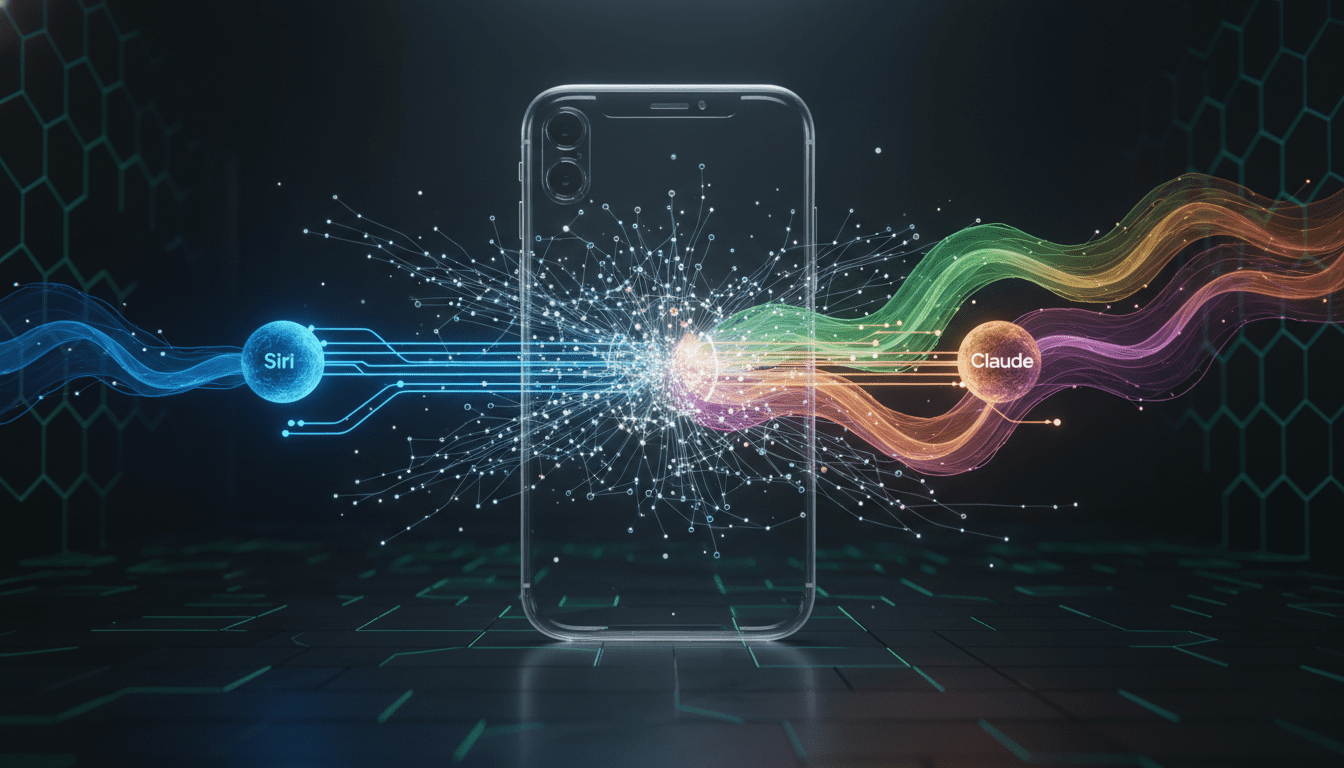
Siri Extensions in iOS 27 Open iPhone to Google Gemini, Claude and Other AI Assistants
iOS 27’s Siri Extensions let users plug Google Gemini, Anthropic Claude and other AI assistants into Siri, reshaping iPhone voice AI and App Store monetization.
Apple is preparing to loosen Siri’s long-standing ties to a single external partner by introducing a new “Extensions” system in iOS 27 that lets third-party AI assistants operate inside the Siri experience. Branded internally as a way to let multiple conversational models act as Siri’s “brains,” Siri Extensions will allow users to select different AI agents — from Google’s Gemini to Anthropic’s Claude and beyond — for specific tasks, transforming the iPhone into a neutral platform for competing large language models and specialized assistants. That change matters because it redefines how voice AI on iPhones will be sourced, how developers will reach users, and how Apple will govern access to one of the most visible consumer AI touchpoints.




What Siri Extensions Are and How They Work
Siri Extensions is reportedly a system-level interface that allows AI apps installed from the App Store to register agents that can respond to voice or text requests routed through Siri. Instead of hardwiring a single external model into the assistant, Apple will offer a plugin-like architecture: an app provides an “agent” that declares the tasks it can perform, and Siri can hand off user queries to that agent when appropriate. The experience is designed to be seamless — a user would ask Siri a question and receive an answer generated by the chosen agent without leaving the Siri overlay.
Technically, Extensions would act as a mediator between Siri’s intent processing and external AI services. Siri would still handle wake words, request routing, and device-level commands, while third-party agents focus on content generation or specialized knowledge. Settings exposed to users are expected to include toggles for which agents Siri may consult, plus per-app permissions and a way to prioritize or set defaults for particular types of queries (coding help, research, travel planning, writing, etc.). Apple may also surface a curated “Siri-compatible” section of the App Store to make it easier for users to discover agents designed to integrate with the assistant.
Why Apple Is Opening Siri to Rival AI
Several strategic forces underlie Apple’s move. First, the AI landscape is diversifying: new models and specialized agents compete on capabilities, latency, domain expertise, and pricing. Locking Siri to a single external model risks delivering a static experience in a rapidly evolving market. By enabling multiple providers, Apple avoids repeated one-off negotiations and can give customers immediate access to innovation from other AI vendors.
Second, the change taps into a clear business opportunity. Allowing third-party agents into Siri creates a new channel for App Store monetization: subscriptions and in-app purchases tied to AI agents could generate revenue that flows through Apple’s existing commerce infrastructure. That arrangement preserves Apple’s control over payments while expanding the variety of experiences available through voice.
Finally, opening Siri aligns with broader developer and partner strategies. A modular Siri that can work with multiple AI ecosystems reduces integration friction for companies that want their models to be reachable by voice on iPhone without building device-specific voice tech. It also positions Apple as an OS-level gatekeeper that balances user choice with platform rules, rather than a single-vendor conduit.
How Users Will Choose and Configure AI Agents
User control appears central to the design. Reports suggest iOS 27 will include a new settings area where people can authorize which agents Siri may use and set defaults for certain categories of tasks. That means a user could prefer one assistant for code debugging and another for travel recommendations, and instruct Siri to route queries accordingly.
Expect the selection process to be driven by a mix of app discovery and explicit permissions. Developers will likely declare the capabilities of their agents when submitting to the App Store; those capability claims will show up in the App Store listing and in Siri’s agent selection UI. Apple may also introduce a permission prompt the first time an agent is invoked through Siri, similar to existing location or microphone prompts — a user must allow the agent to operate with Siri before it can be used.
Because voice is a low-friction interface, transparency and easy controls will be important. Practical design considerations include a clear label showing which agent handled a response, an undo or “ask a different agent” option, and a simple path to revoke an agent’s Siri permission. These affordances will shape user trust and adoption.
Developer and App Store Implications
For developers and AI companies, Siri Extensions represent both a new distribution channel and a set of operational questions. On the positive side, being usable directly through Siri removes a layer of friction: an app’s capabilities become accessible without the user opening the app, potentially increasing engagement and subscription conversions. A well-integrated agent could capture repeated voice interactions, driving recurring revenue.
However, Apple’s platform rules will matter enormously. Agents that monetize via subscriptions or in-app purchases will likely have to use App Store billing, which means Apple’s cut applies unless developers qualify for alternative arrangements. That introduces a commercial calculus: the opportunity to reach Siri users must be balanced against the revenue share and App Store review constraints.
From a technical standpoint, apps will need to implement the agent interface Apple defines, potentially including metadata about supported intents, content filtering, latency expectations, and safety controls. Developers will also need to optimize for voice-first interactions: responses must be concise, context-aware, and robust against ambiguous prompts. For enterprise and vertical AI providers, Siri Extensions open the possibility of offering specialized assistants (legal research, medical triage, code review) that reach users directly through voice, provided they meet Apple’s privacy and policy requirements.
Privacy, Security and Trust Considerations
Opening Siri to outside agents raises immediate privacy and security questions. When a third-party agent answers a Siri query, what data leaves the device? Does Siri send a full transcript, partial context, or only a minimal intent descriptor? How long will third parties retain interaction data, and will Apple require adherence to privacy labels or data-retention standards specific to Siri usage?
Apple’s historical emphasis on privacy suggests it will build guardrails around data flow: local intent parsing to reduce unnecessary data transfer, permission dialogues for agent access, and App Store policies limiting off-platform data resale. That said, policy enforcement will be crucial. Agents that use cloud-based models may transmit context-rich queries that could include personal data; Apple must ensure developers disclose such practices and give users tools to opt out.
Security also extends to the integrity of agent responses. Voice-based agents can be used to trigger actions or provide advice; mechanisms to flag or sandbox agents that return unsafe or misleading outputs will be needed. Apple could enforce safety testing, content moderation standards, and technical constraints — for example, preventing agents from executing device-level commands unless explicitly authorized and verified.
What This Means for Competing AI Platforms and the Industry
If Apple ships support for multiple AI agents inside Siri, the iPhone becomes a battleground for conversational AI providers. Major players like Google and Anthropic will gain an alternative way to reach iPhone users without being embedded at the OS level, while startups with niche expertise can compete on specialized tasks. That dynamic could accelerate innovation, as providers optimize models for voice latency, domain accuracy, and concise verbal outputs.
For broader industry trends, the move underscores a shift toward interoperability at the user interface level: rather than each company attempting to own the entire assistant experience, platforms may act as neutral conduits that let multiple models compete on merit. This could push AI vendors to improve customer-facing metrics — quality, response time, transparency — and to offer differentiated subscription tiers.
At the same time, platform owners like Apple retain significant power through access control, billing integration, and review policies. The economics of App Store revenue sharing will shape which agents thrive. Enterprises and developers should weigh the trade-offs between reach and margin when deciding whether to prioritize Siri integration versus building standalone channels.
When to Expect Siri Extensions and WWDC Preview
Apple tends to unveil major OS updates and developer frameworks at its Worldwide Developers Conference, and reports indicate iOS 27 and its Siri Extensions may be showcased at WWDC on June 8. Expect a developer preview soon after the keynote and a public beta cycle through the summer, followed by a general release in the typical fall timeframe for iOS updates.
Developers should watch for early SDKs and documentation that detail the agent registration process, intent schemas, and privacy constraints. Apple could also announce a validation or certification program for Siri-compatible agents to ensure quality and compliance. For users, initial availability may be limited to selected regions or devices while Apple refines the experience.
How Businesses and Developers Can Prepare
Companies that build AI models, voice experiences, or productivity tools should start planning for Siri integration now. Practical preparation steps include:
- Design voice-optimized responses: prioritize brevity, clarity, and follow-up prompts suitable for spoken interaction.
- Map capabilities to intents: define which queries your agent should handle and how it should fall back to Siri or other agents for unsupported tasks.
- Review App Store policies: ensure subscription models, data handling practices, and content moderation meet Apple’s standards.
- Instrument performance and latency: voice interactions magnify user sensitivity to delays; optimize endpoints and caching strategies.
- Prepare privacy disclosures: craft clear, concise explanations of what data your agent uses and how it is stored or shared to reduce friction during permission prompts.
- Consider multi-channel strategy: weigh the benefits of Siri integration against other voice platforms and in-app experiences to determine where to invest engineering resources.
For enterprises, particularly those with internal AI assistants, building a Siri-compatible agent could open a new employee productivity channel — but that will require alignment with corporate security policies and possibly a managed deployment model.
Related technologies and ecosystem considerations
Siri Extensions will intersect with several adjacent domains: AI model hosting and inference platforms, developer tooling for intent mapping, CRM systems that could surface personalized information through voice, and security stacks for protecting sensitive data. Integration with workflow automation platforms and productivity suites could allow users to ask Siri to trigger multi-step processes, pulling data from CRM, calendar, and project-management tools. Such cross-product opportunities make Siri Extensions relevant not only to consumer-focused AI startups but also to enterprise software vendors and automation platforms.
Apple’s approach will also influence how other OS vendors position their assistants and developer ecosystems. If Siri becomes a neutral conduit that supports multiple vendors while enforcing strong privacy controls, it could set a precedent that other platforms emulate, altering how conversational AI services prioritize platform integrations.
Apple’s existing "Apple Intelligence" efforts and prior partnerships with conversational AI vendors provide a contextual backdrop: earlier arrangements favored specific partners, but a modular Extensions model signals a move toward openness that retains platform oversight while enabling competition among models.
A forward view on regulatory and policy implications
As multiple AI agents integrate at the OS level, regulators may scrutinize how platform operators moderate content, ensure competition, and protect consumer data. Compliance teams should anticipate questions about algorithmic transparency, data portability, and anti-competitive practices. Apple will likely need to balance developer flexibility with guidelines that prevent deceptive agent behavior or unfair practices, especially if the App Store becomes a critical acquisition channel for AI subscriptions.
Final paragraph (forward-looking)
Over the next year, watch for a rapid iteration cycle: initial Extensions implementations will expose usability gaps, privacy edge cases, and new business models, and those lessons will shape both developer practices and platform policies. If Apple can deliver a clear, privacy-respecting integration model that makes it easy for users to choose and trust external agents, Siri could become a multiprovider hub that accelerates conversational AI adoption across consumer and enterprise use cases — while also redefining how app marketplaces capture value from the next wave of AI services.