
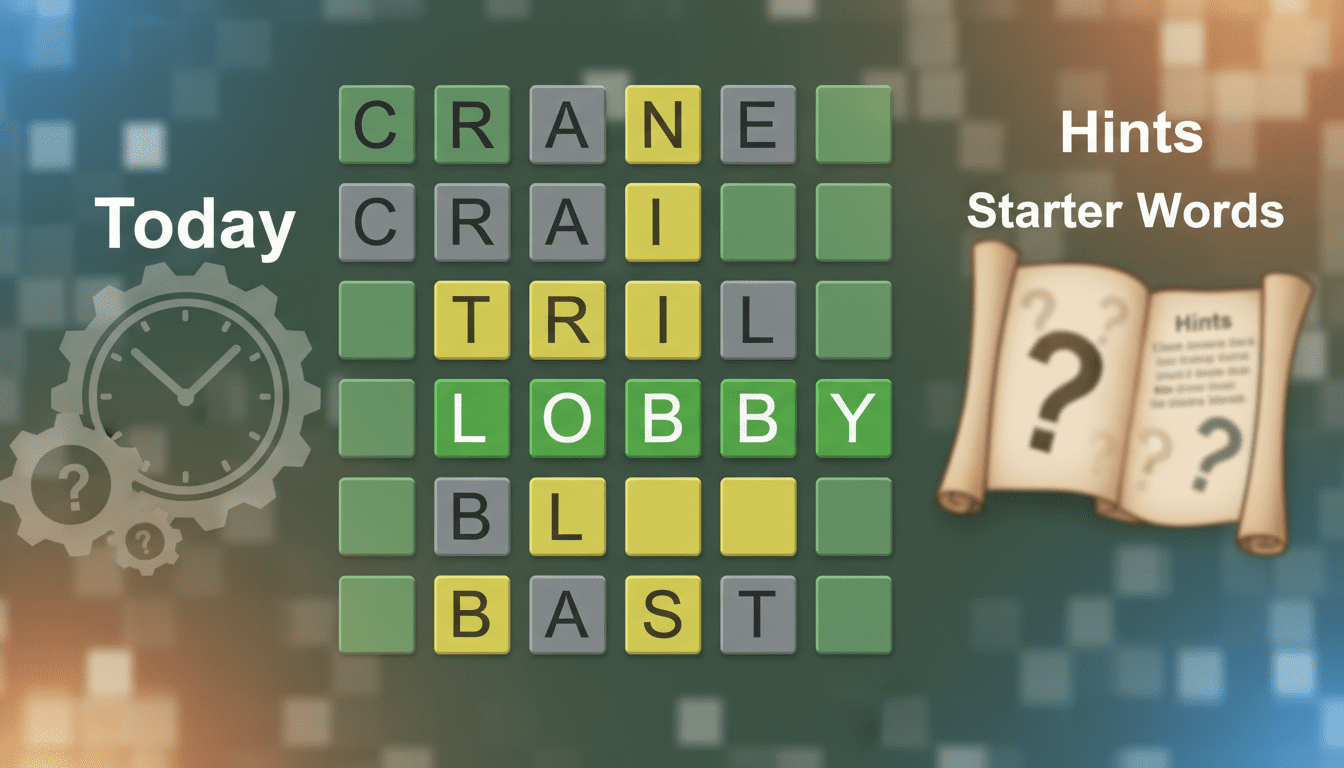
Wordle: How to Solve Today’s Puzzle (Answer LOBBY), Improve Your Strategy, and Compare Alternatives
Wordle strategies, daily hints, and practical workflows: learn what Wordle is, who should play, its key features, and how to improve your daily solve.
Wordle is a compact, five-letter daily word puzzle that challenges players to deduce a target word in six guesses. It’s designed for casual players, language learners, and anyone who enjoys short, logical puzzles that reward pattern recognition and vocabulary knowledge. The game solves the problem of bite-sized mental stimulation by offering a single solvable challenge each day with immediate feedback after every guess. In this article you’ll find today’s Wordle answer and the clues that lead to it, an analysis of recurring patterns like repeated letters and “sometimes” vowels, practical starter-word and elimination workflows, a breakdown of Wordle’s core features, a comparison with similar daily puzzle formats, and guidance on who benefits most from playing. Use these sections to sharpen your approach to today’s puzzle (answer: LOBBY), to learn from a short run of recent solutions, and to build repeatable daily routines that improve accuracy and speed.




Key Features of Wordle
Wordle’s power lies in its simplicity: five-letter targets, six guesses, and immediate color-coded feedback. That compact rule set creates a highly focused problem-solving loop—each guess yields three types of information: correct letter in correct position, correct letter in wrong position, or letter absent from the target. The single-puzzle-per-day design encourages communal play and reduces decision fatigue, since everyone receives the same word at roughly the same time worldwide.
Other notable features that shape play and strategy include the game’s fixed guess limit, the restricted word list that excludes obscure proper nouns and many specialized terms, and the hidden vocabulary rules that determine which answers appear. The interface typically hides solver aids such as scoring or hints, which keeps the challenge purely deductive rather than gamified by points.
For players, those design choices mean strategy centers on information efficiency: choosing starter words that maximize useful feedback, using subsequent guesses to test high-value letters and positions, and reserving later turns for targeted confirmation. The presence of repeated letters in answers, the occasional use of the letter Y as a “sometimes vowel,” and the recurring use of unusual consonants all influence which heuristics are most effective.
Who Should Use Wordle
Wordle appeals to a broad audience but is particularly well suited to several groups. Casual players who want a short, daily mental task will appreciate the predictable time commitment and straightforward rules. Language learners benefit from the repeated exposure to common English words and the need to think about letter patterns; Wordle can be adapted easily as a classroom warm-up or homework exercise. Educators can use it to reinforce vocabulary, spelling conventions, and reasoning under constraints.
People who enjoy social routines—sharing results with friends or comparing streaks—will find Wordle’s single-daily-puzzle model conducive to conversations rather than continuous play. Teams and workplaces often adopt Wordle as a micro-break activity that fosters friendly competition and quick collaborative problem solving.
That said, Wordle is less ideal for those seeking long-form puzzles, deep narrative engagement, or accessibility accommodations that the basic interface doesn’t address out of the box. Players with limited vocabularies or non-Latin-script backgrounds may find occasional answers frustrating without supplemental learning aids. For people who want more puzzles per day or longer challenges, there are other formats—some discussed later—that expand on Wordle’s design.
Wordle Daily Strategies and Workflows
A disciplined workflow will typically yield better results than random guessing. Successful routines balance exploration (gaining information about which letters are present) and exploitation (locking down positions and repeating letters when appropriate). Below is a practical five-step workflow many experienced players use:
1. Pick a high-information starter word. Choose a five-letter word that contains multiple common consonants and at least one vowel—examples often include a mix like S, R, T, L, N, E, A, O. The goal is to get the broadest possible coverage of frequent letters in the first guess.
2. Evaluate feedback and eliminate systematically. Use the color-coded feedback to rule letters in or out. If a letter returns as present but misplaced, plan a guess that repositions it into the suspected positions while testing new letters.
3. Test for double letters early when hints suggest repetition. If the feedback implies a repeated character—two instances of the same letter—design a guess that either confirms duplication (by placing that letter twice in different slots) or rules it out.
4. Treat Y as a candidate vowel. When response patterns show a single traditional vowel or fewer vowels than expected, consider words where Y functions as the vowel. Many answers use Y as the only vowel-like character, which shifts strategy: prioritize placements that allow Y to occupy potential vowel slots.
5. Reserve final turns for precise confirmation. After the first three guesses reveal structure, use the fourth and fifth guesses to test combinations that would lead to the target in the sixth guess. Avoid introducing too many new letters late in the process unless you need to discover a missing vowel or confirm a double letter.
Worked example using today’s puzzle: the puzzle’s clues indicate a repeated letter, one true vowel and one sometimes vowel, it begins with L and ends with Y, and its meaning relates to the room where guests check in at a hotel. Those constraints narrow options dramatically. Given repetition and the pattern L _ _ _ Y with L at position one and Y at position five, common constructions include LOBBY, LETTER-like forms, and LILLY-style variants. Cross-referencing the meaning of a hotel check-in area immediately points to LOBBY. If you were following the workflow, the early guesses would have confirmed the L and Y placements and the presence of a repeated B, leading to the correct solution by the final guess.
Wordle Data: Letter Frequency, Patterns and Recent Answers
Understanding common letter distributions and recent answer patterns can improve starter-word selection and mid-game decisions. Historically, vowels like E, A, O and consonants such as R, S, T, L, N appear with high frequency across five-letter words, so many players begin with words that include a mixture of these letters. Repeated letters are less common overall but do appear regularly enough that a mid-game test for duplication—especially after seeing one instance of a letter—pays dividends.
A specific recent-run example illustrates variety and the strategic demands players face. In a short sequence of puzzles, the following answers occurred: LINEN (March 3), THEFT (March 4), SHEEP (March 5), GUNKY (March 6), VOGUE (March 7). Today’s answer is LOBBY. This sequence shows a mix of common-letter reliance (LINEN, THEFT), double-letter cases (SHEEP, LINEN has repetition in pattern though not contiguous), and less common letter appearances (GUNKY, VOGUE). GUNKY and VOGUE highlight how occasional unusual consonants and O-U vowel combinations require flexibility in starter choices.
Practical takeaways from this run:
– Keep at least one starter word in your rotation that aggressively tests vowel space (for example, including A, E, O).
– Include at least one starter or second guess aimed at common consonants like R, S, T, L, N.
– Be ready to pivot to duplication testing if feedback hints at repeated letters—placing the same letter twice in a subsequent guess is a low-cost way to confirm repetition.
– Consider the possibility of Y functioning as the only vowel; that shifts the candidate pool significantly and should prompt rapid testing once traditional vowels are mostly excluded.
How Wordle Compares to Alternatives
Wordle’s minimalist, one-puzzle-per-day approach distinguishes it from many other word and logic games. Alternative formats expand in three main directions: quantity, complexity, and randomness. Quantity-focused variants deliver multiple puzzles per day or allow continuous play, which suits players seeking more time-on-task. Complexity-focused versions increase word length, add rules (such as thematic constraints), or produce multi-word puzzles that require extended deduction. Randomized or adversarial variants change the word list dynamically or respond to player guesses strategically, providing a more combative experience.
Compared to daily crosswords, Wordle is faster and more deterministic: crosswords require broader knowledge and thematic thinking, while Wordle rewards pattern deduction and letter probability assessment. Compared to multi-word or multi-grid clones, Wordle’s single-answer limit emphasizes perfecting a concise skill set—starter selection, positional logic, and duplication awareness—rather than sustaining long-form solving stamina.
For players deciding which format to adopt, consider the following trade-offs:
– If you want short, sharable puzzles that create communal conversation, Wordle’s daily model is optimal.
– If you crave volume and practice, look for formats that permit multiple puzzles or customizable difficulty.
– If you enjoy meta-strategy and adversarial play, seek out versions that modify the answer space or introduce bluffing mechanics.
Wordle’s Role in Daily Habit and Cognitive Training
Wordle’s daily cadence encourages it to function as a ritual—an accessible mental warm-up that fits easily into morning routines, coffee breaks, or team standups. That ritual aspect supports habit formation: a single, predictable task every day is far easier to maintain than an open-ended commitment. For educators and cognitive trainers, Wordle offers repeated, measurable practice in pattern recognition, working memory, and probabilistic thinking.
Beyond individual cognitive benefits, Wordle has social utility. Sharing streaks or discussing particularly clever answers fosters lightweight social exchanges that can boost morale and create conversational anchors. In workplace settings, a short group solve can serve as an icebreaker that still exercises reasoning skills without taking excessive time.
Limitations remain: the one-puzzle model means less opportunity for progressive skill-building within the game itself; players who want structured difficulty ramps or adaptive learning will need to supplement Wordle with other tools. The hidden nature of the answer list can also create frustration for players who suspect obscure vocabulary will appear; transparent or educational variants better serve learners who need clearer scaffolding.
Practical examples of incorporation:
– Morning routine: solve Wordle right after email triage to establish a focused starting point for the day.
– Classroom use: present a daily Wordle as a five-minute bell-ringer, then discuss strategies and common pitfalls.
– Team ritual: reserve two minutes during a meeting for a collaborative solve or to compare how different team members approached the puzzle.
Final paragraph summarizing significance and long-term relevance
Wordle’s enduring appeal stems from the way its simple rules produce rich strategic behavior: compact constraints generate meaningful decisions about starter words, duplication checks, and the role of less-common letters such as Y. The puzzle’s single-daily format fosters a social rhythm and predictable mental engagement that many players appreciate, while the variety of answers—illustrated by recent solutions like LINEN, THEFT, SHEEP, GUNKY, VOGUE, and today’s LOBBY—keeps the game fresh and instructive. Whether used as a quick cognitive warm-up, a classroom activity, or a shared habit among friends, Wordle remains a concise tool for sharpening pattern recognition, expanding vocabulary, and enjoying communal problem solving over the long term.