Anthropic Opus 4.7 Sharpens Software-Engineering Skills and Visual Reasoning as Mythos Stays in Controlled Pilots
Anthropic Opus 4.7 improves software engineering, visual reasoning and long-running task performance, remaining the top public model while Mythos is piloted.
Opus 4.7 arrives with targeted improvements in coding and long-running tasks




Anthropic has released Opus 4.7, an incremental update to its Opus family that the company says focuses on better performance in software engineering workflows and on handling complex, long-running tasks. According to Anthropic’s published benchmarks, the new release delivers measurable gains in “agentic coding” and shows stronger capabilities in visual reasoning and creative outputs such as slide and presentation design. The company also says it took steps to reduce certain cyber-related capabilities in Opus 4.7 before making it available.
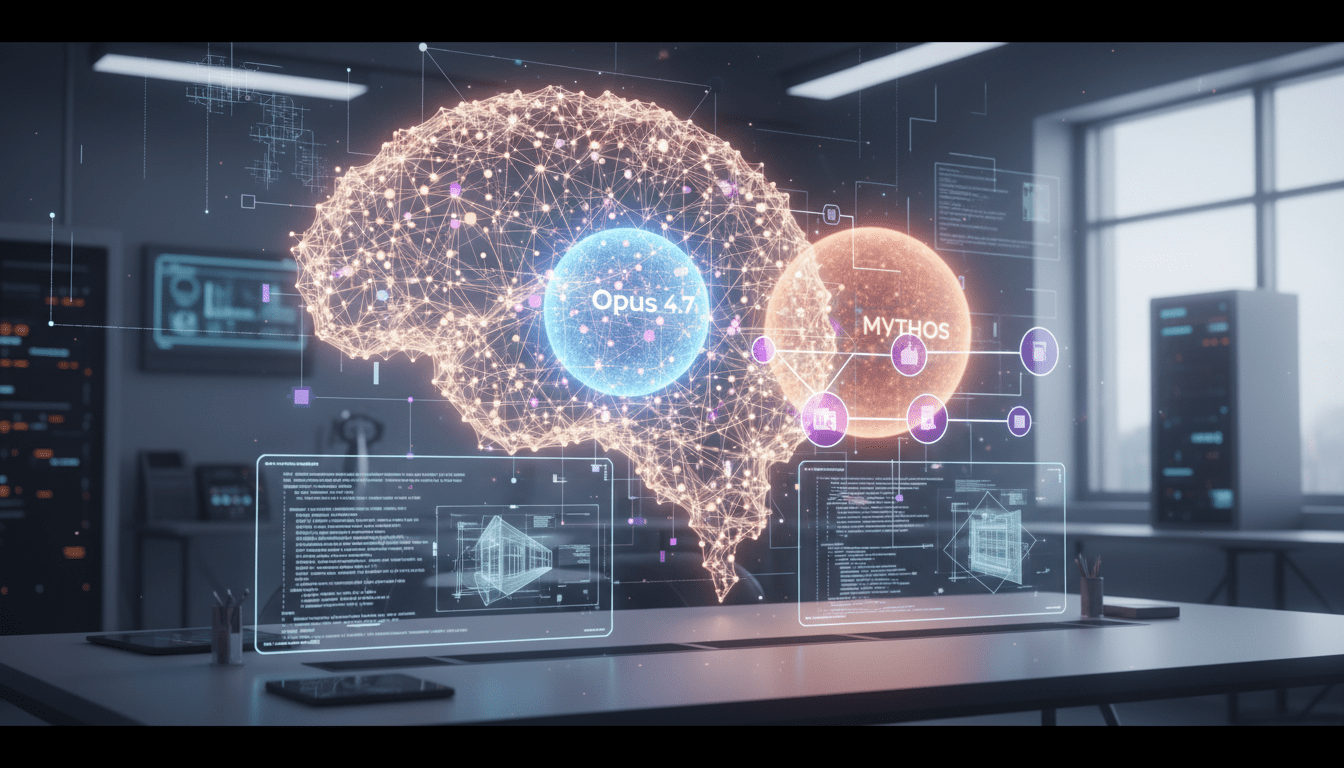
The release is notable because it follows a brief preview of a more powerful model, Mythos, which Anthropic has shown to a small set of customers. For the immediate future Opus 4.7 remains the most powerful model Anthropic is distributing broadly; Mythos has been made available only in limited pilots with selected banking and government institutions.
What Anthropic claims Opus 4.7 does better
Anthropic frames Opus 4.7 as a model tuned for a set of practical improvements rather than a broad leap in general capability. The company’s own benchmark results highlight more than 10% improvement in agentic coding tasks — a category that describes multi-step, goal-directed coding behaviors — and better performance on visual reasoning challenges. Anthropic also points to gains in creative tasks such as designing presentations and slides, suggesting the model is better at multimodal composition and ideation for business outputs.
Anthropic has emphasized that some of those gains come alongside deliberate limitations: the firm experimented with ways to tone down the model’s cyber capabilities before release. That framing signals a design trade-off intended to balance utility for enterprise users against the risks of misuse.
Benchmarks, claims and available evidence
Anthropic published benchmark results alongside the Opus 4.7 announcement. The company’s materials present relative improvements in specific areas — notably agentic coding — and highlight qualitative advances in visual reasoning and creative design. The announcement describes Opus 4.7 as “far better” on those fronts than previous versions by the company’s own measures.
Readers should note the distinction between vendor-published benchmarks and independent testing: the improvements cited here come from Anthropic’s benchmarks and messaging. Anthropic’s claim that Opus 4.7 will be the company’s most powerful publicly available model for at least the next few weeks establishes a clear, time-limited posture for the public product line while Mythos remains under more restrictive access.
Mythos preview and restricted access strategy
Anthropic’s Opus 4.7 launch came shortly after the company previewed Mythos to a select group of customers. Anthropic positions Mythos as a successor to Opus that is more broadly capable; in the Opus announcement the company said Opus 4.7 would not match Mythos’s breadth. But Anthropic has signaled that Mythos will not be released to the general public immediately. Instead, Anthropic has run controlled pilots, granting access to banking and government institutions to demonstrate capabilities and collect operational feedback under supervised conditions.
The decision to hold Mythos in pilot contrasts with making Opus 4.7 widely available and reflects an access strategy that attempts to balance commercial demand with operational and security considerations. Anthropic’s reference to having “experimented” with mitigating cyber capabilities in Opus 4.7 indicates the company is actively adjusting capability profiles as part of product release planning.
Security and geopolitical concerns shaping access
Security concerns are a central theme in Anthropic’s recent product decisions. The company has previously expressed alarm about the potential for its models to be distilled — that is, copied or approximated by third parties — and then reconfigured by operators in other jurisdictions. Anthropic has publicly accused firms it says have distilled its models, and highlighted the risk that distilled models can be repurposed as tools in cyberattacks. The company singled out examples of Chinese open-source models and actors such as DeepSeek in this context.
Anthropic’s caution around Mythos reflects these risks: a highly capable model that becomes available widely could be exploited for cyber operations or be distilled and redistributed. Those anxieties have influenced access choices and the tone of the company’s degradation or “toning down” of certain model capabilities ahead of public deployment.
Those security dynamics have overlapped with government scrutiny. The U.S. federal government recently prohibited federal agencies from using Anthropic’s Claude family and designated Anthropic a “supply chain risk.” That action — described as occurring “last month” in Anthropic’s announcement context — has not entirely ended interactions: reports indicate the White House has sought channels to allow some government access to Mythos in controlled ways, and Anthropic has been running pilots for select institutions. The company is also preparing to contest the federal ban legally, according to its public statements. Meanwhile, reporting suggests federal use of the model may have persisted in some form despite the ban.
Opus 4.7 in the context of Anthropic’s earlier product choices
Anthropic’s decision to limit certain capabilities in Opus 4.7 follows prior examples of capability and product rebalancing. In late 2025 the company launched Claude Haiku, which it described as its fastest and most efficient model at that time and cheaper to build. Claude Haiku was framed as an optimization for cost and speed rather than raw, unconstrained capability; Opus 4.7 continues that pattern of delivering practical performance improvements while managing expense and risk.
The company’s public messaging around Opus 4.7 suggests that releases are no longer judged solely on peak performance. Instead, Anthropic appears to be emphasizing controllability, enterprise suitability, and mitigations designed to limit misuse — a posture that has material implications for product roadmaps and pricing.
How enterprises are being positioned to use Opus and Mythos
Anthropic’s product rollout signals a two-tier approach for enterprise customers. Opus 4.7 is being positioned as the broadly available workhorse with improved abilities for coding, visual reasoning and long-form or multi-step tasks that enterprises commonly require. Anthropic’s mention of improved presentation design and connections to business workflows aligns with the company’s broader push into enterprise use cases, where automation of data-to-presentation flows and integrated productivity workflows are highly valued.
Mythos, by contrast, has been reserved for controlled pilots with financial and government institutions. That selective access underscores Anthropic’s intent to expose Mythos to regulated environments first, allowing supervised evaluation and risk assessment before wider distribution.
Industry parallels: other firms restricting access for safety reasons
Anthropic is not alone in limiting access to advanced models. OpenAI has opened a cyber-focused model — GPT-5.4-Cyber — to a similarly narrow set of institutions because of cybersecurity risks, and major tech companies such as Google and Meta have withheld highly capable video models from public release over concerns about misinformation and deepfakes. These examples illustrate a broader industry trend: firms are increasingly balancing commercial openness against control measures in response to misuse, geopolitical risk and regulatory scrutiny.
That trend has real effects on how organizations procure AI tools, run pilot programs, and design internal governance for model use. For vendors, it means designing tiered access and differentiated models that reflect acceptable risk profiles for different classes of customers.
Practical guide: what Opus 4.7 does for developers and businesses
Anthropic’s own statements about Opus 4.7 paint a practical picture for users and buyers. The update is aimed at making the model more effective for:
- Software engineering tasks that require multi-step planning and code generation, where the company reports more than 10% improvement in agentic coding benchmarks.
- Visual reasoning tasks that combine text and imagery to reach conclusions or generate outputs.
- Creative deliverables, specifically slide and presentation design, where Anthropic says Opus 4.7 shows greater inventiveness.
In operational terms, Anthropic has indicated that Opus 4.7 will remain the most powerful openly available model for at least several weeks while Mythos remains in pilots. That makes Opus 4.7 the immediate option for enterprises that require a capable, publicly accessible model for production or evaluation, with Mythos reserved for controlled institutional access.
How it works in practice: Anthropic’s documentation and benchmark notes describe the improvements primarily as tuning and capability adjustments rather than wholesale architectural changes. The company also reports deliberate reductions to some “cyber capabilities,” implying a combination of training-time, inference-time, or policy-level controls applied before release.
Who can use it and when: Opus 4.7 has been announced for broad availability; Anthropic’s messaging indicates a limited timeframe in which Opus will sit as the top public offering while Mythos is piloted selectively. Mythos access has been restricted to pilots with banks and government agencies and is not being rolled out broadly at this stage.
Broader implications for developers, businesses and the AI industry
Anthropic’s Opus 4.7 release — and the restrained rollout of Mythos — illustrates several industry-wide pressures that will shape developer and enterprise choices in the months ahead.
First, capability trade-offs are becoming product features. Vendors now prominently balance raw capability against controllability and safety, making “less capable but safer” models a deliberate product choice rather than a compromise. That recalibrates expectations for developers who previously optimized around performance alone; future system designs will need to account for the capability profile of the model they integrate.
Second, access stratification will influence procurement and integration strategies. Enterprises that gain early access to high-end models through pilots may enjoy competitive advantages, but they will also bear greater responsibility for governance, auditing and risk mitigation. Organizations without access will rely on the more conservative public releases — like Opus 4.7 — and may need to design around feature gaps between public and pilot-tier models.
Third, geopolitical and security dynamics are now a central axis of product policy. Claims about model distillation and cross-border reconfiguration introduce a new dimension to supply-chain thinking in AI: vendors and customers must consider not only the model’s capabilities but how derived or distilled versions can propagate beyond intended controls.
Finally, the market for specialist models that are cheaper and more efficient — as Anthropic framed Claude Haiku — remains strong. Cost, latency, and carbon or infrastructure considerations will continue to shape choices alongside safety and capability.
Developer and integration considerations without overreaching
For engineering teams evaluating Opus 4.7, the key considerations drawn from Anthropic’s announcement are straightforward: the model is positioned to help with complex coding workflows and multimodal reasoning, but Anthropic has applied mitigations around cyber capabilities. That combination suggests Opus 4.7 may be a fit for organizations that need stronger multi-step automation and visual reasoning but do not require the broadest possible capability set.
Integrators should plan for governance controls, audit logging, and usage monitoring to align with the risk posture Anthropic itself is adopting. Enterprise buyers will want contractually specified terms on access, support for pilot-to-production transitions, and clarity on how capability differences between Opus 4.7 and any pilot-tier model like Mythos are resolved.
Regulatory and procurement ripple effects
Anthropic’s public positioning — including the U.S. federal ban on Claude-family models for agencies and the company’s subsequent pilots with government institutions — will likely feed into procurement discussions and regulatory reviews. Government agencies and regulated industries will face pressure to reconcile security restrictions with operational needs, and vendors will be asked for stronger guarantees about provenance, non-diversion, and post-deployment monitoring.
At the same time, Anthropic’s legal pushback against federal restrictions signals that disputes over supply-chain risk designations may be litigated rather than resolved purely through policy channels. That legal and policy uncertainty is another factor enterprises must weigh as they evaluate model selection and contracts.
How this shapes the competitive landscape
Anthropic’s approach — a staggered release with conservative feature adjustments for public models, accompanied by pilots for more powerful systems — mirrors similar moves by other major suppliers and creates a competitive environment where access, controls, and enterprise readiness are differentiators alongside raw capability. Vendors that can demonstrate robust safety guardrails, transparent benchmarking, and clear access frameworks may gain trust among regulators and large institutional customers, even if their public releases are initially less capable than private pilots.
Forward-looking perspective on model availability and enterprise adoption
Anthropic’s release of Opus 4.7 and its cautious handling of Mythos underscore a broader phase in commercial AI: capability development is now intertwined with access governance, security mitigation, and political scrutiny. For enterprises and developers, the practical takeaway is that model selection will need to balance functional needs with compliance and risk appetite. Anthropic’s Opus 4.7 provides an immediate, publicly available option with explicit improvements in coding and visual reasoning, while Mythos illustrates the path of staged rollout for higher-risk, higher-capability systems.
As vendors continue to refine models and pilot access strategies, expect more tiered offerings, more explicit safety trade-offs in product descriptions, and ongoing debates about how public interest, national security, and commercial demand should shape who gets access to the most powerful AI models and under what conditions.