
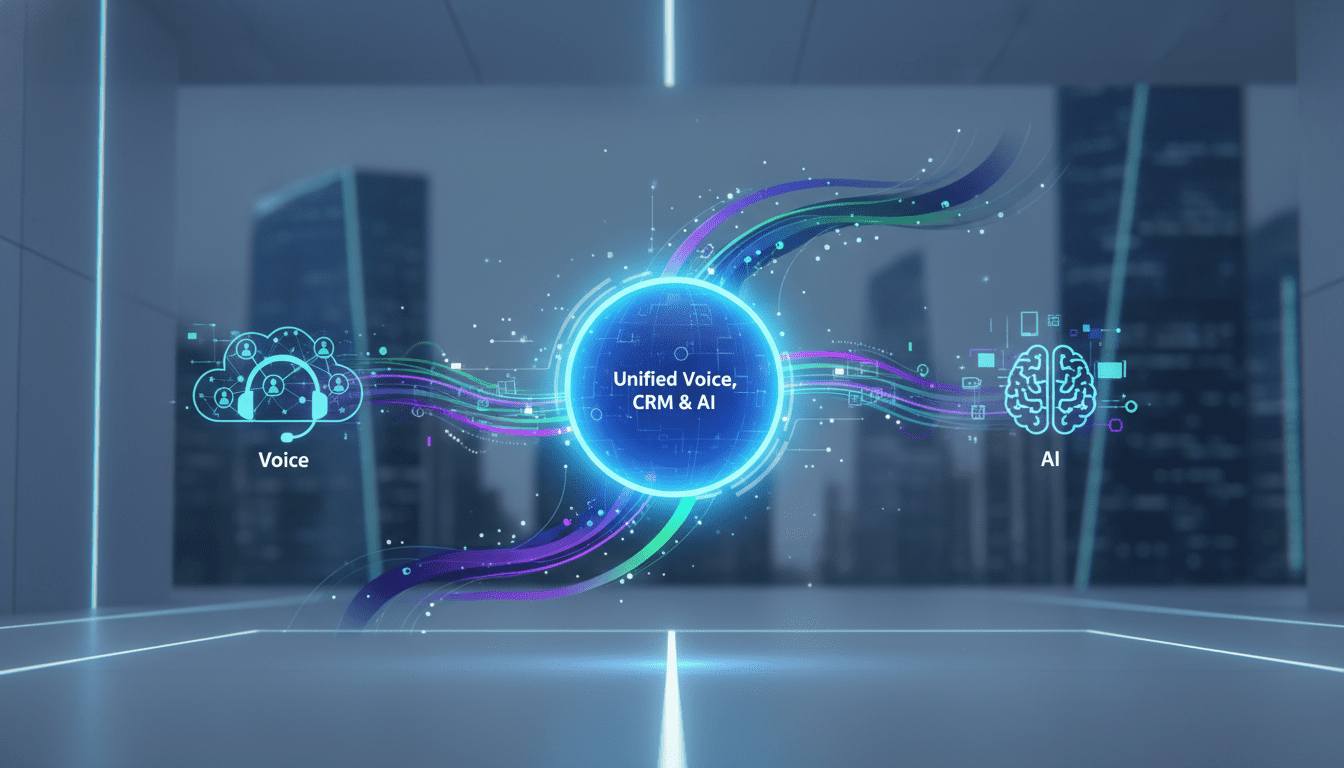
Agentforce Contact Center: Salesforce Reimagines the Contact Center with Native Voice, CRM-Aware AI and Unified Channels
Agentforce Contact Center unifies voice, digital channels, CRM and autonomous AI agents on Salesforce’s native platform to cut integration costs and boost CX.
Agentforce Contact Center marks a significant shift in how organizations operate customer service: Salesforce has moved beyond piecemeal integrations and into a native, CRM-aware contact center designed to collapse the long-standing “integration tax” between telephony, CRM, bots and analytics. By embedding voice and digital channels directly into the Salesforce platform and pairing them with autonomous AI agents that can access full customer histories, Agentforce aims to make handoffs seamless, reduce friction for agents and customers, and enable proactive engagement across the customer lifecycle. For enterprises wrestling with fragmented stacks and rising expectations for immediate, contextual service, this is a strategic pivot with operational and competitive implications.




A native stack replaces stitching: the architectural shift behind Agentforce Contact Center
Historically, contact centers have been assembled from best-of-breed pieces — CRM from one vendor, telephony from another, a separate bot engine and an analytics layer — stitched together with APIs, middleware and custom code. That architecture creates latency, duplicated effort and a persistent context gap when customers move between channels. Agentforce Contact Center addresses that by making voice and digital channels first-class capabilities within Salesforce, enabling AI and humans to consume the same, up-to-date customer record without traversing brittle integration points.
The value proposition isn’t merely convenience. When voice is CRM-aware natively, event data, purchase history, marketing engagement and case records are available instantly, which fundamentally changes automation possibilities. Autonomous agents can act on lifecycle signals — from churn risk to recent purchases — and escalate to human agents with a complete transcript and state, rather than a fragmentary snapshot. That shift supports a move from reactive, ticket-driven support to anticipatory, intent-driven engagement.
How Agentforce Contact Center works and who benefits
Agentforce Contact Center blends four core elements: unified channels (voice and digital), native CRM data access, autonomous AI agents, and embedded workforce/analytics tools. Practically, that means:
- Voice and messaging sessions originate and terminate inside Salesforce, removing the need for external telephony platforms to shuttle data back and forth.
- AI agents run with direct access to the canonical customer profile — marketing touches, purchases, subscriptions, prior cases and entitlements — enabling richer conversational context and decision-making.
- When a human agent is required, the handoff is a context-preserving transfer: transcripts, suggested actions and relevant records appear in the agent workspace immediately.
- Workforce management, quality monitoring and analytics are integrated into the same environment, so metrics like AHT, FCR and sentiment are derived from one source of truth.
Who can use it: large enterprises with complex customer lifecycles, mid-market firms looking to simplify stacks, and customer experience teams aiming to operationalize AI agents will see the most immediate benefit. Organizations that have invested heavily in third-party CCaaS platforms may adopt Agentforce incrementally — using the native option for some contact types while retaining partners for others.
Availability and timing: rollout strategies will vary by region and customer need; for many customers, the practical path will be hybrid, where Salesforce supports both its native contact center and partner CCaaS integrations so enterprises can migrate on their own schedule. Because adoption touches compliance, telephony regulation and carrier relationships, migration calendars should be developed with operational and legal stakeholders in mind.
Customer experience impacts: fewer repeats, faster resolution, stronger retention
The immediate customer-facing benefits are concrete. When conversational AI and agents operate from the same dataset, the familiar “please repeat your account number” experience disappears. Instead of repeating context at each touchpoint, customers benefit from:
- Reduced Average Handle Time (AHT) because agents spend less time gathering background and more time resolving issues.
- Higher first-contact resolution (FCR) driven by consistent, context-rich guidance across both automated and human interactions.
- Lower churn risk as friction points shrink; customer loyalty improves when organizations consistently resolve issues quickly and avoid repeated transfers.
Beyond these metrics, Agentforce enables proactive outreach. Because the platform can surface lifecycle signals in real time, businesses can reach out with relevant offers, renewals or remediation before a simple inbound support call becomes a lost customer.
Operational design: what implementation teams must consider
Deploying a unified system is not just a technology project — it’s an operational redesign. Implementation teams should focus on four pillars:
- Data hygiene and model access: ensure CRM records are accurate, deduplicated and accessible to AI agents with clear permissioning.
- Conversation design and escalation policies: map agentic workflows that define when an AI should resolve, when to escalate, and how to present context to human agents.
- Telephony and regulatory readiness: voice requires carrier agreements, E911 handling, call recording policies and data residency planning.
- Training and change management: agents and supervisors will need new workflows, dashboards and governance to take advantage of the integrated experience.
For systems integrators, success will come from shifting consulting conversations away from connecting APIs toward designing “agentic architecture” — how autonomous agents behave, what ethical and compliance guardrails exist, and how workflows map to revenue and retention goals.
Industry implications: what Agentforce means for CCaaS and competitors
Salesforce stepping into a native contact center changes competitive dynamics. CCaaS providers historically coexisted with CRM vendors through integrations; a native contact center reduces the need for complex integrations and may accelerate consolidation or acquisitions. Vendors to watch include ServiceNow, NICE, Amazon Connect and established CCaaS players — any of which could respond with tighter CRM integrations, expanded AI capabilities, or by pursuing acquisitions to fill platform gaps.
For ServiceNow, which has historically favored partnership over running its own voice network, a strong showing from Salesforce could prompt strategic moves — possibly acquisitions of CCaaS pure-plays to maintain parity. Conversely, larger CCaaS providers might pursue deeper CRM capabilities to avoid commoditization. The short-term practical reality, however, is that many enterprises will remain hybrid because the technical and regulatory cost of switching voice infrastructure at scale is high.
Partner evolution: from system plumbers to strategic architects
Systems integrators and resellers should interpret Agentforce as a market signal: the plumbing work that paid for years will shrink, but opportunity remains in higher-value services. Partners who embrace agentic design will help clients with persona-driven agent behaviors, ethical AI governance, compliance mappings and change adoption. Those who double down on integration middleware risk commoditization; those who offer transformation consulting, conversational design, and orchestration of agentic workflows will be in demand.
This change also reshapes partner roadmaps: training on Salesforce’s agent tooling, certifications for conversational AI governance, and IP assets for migration accelerators will differentiate leading SIs.
Developer and AI implications: orchestration, observability and multi-agent control
Agentforce does more than host AI agents; it introduces orchestration challenges. Enterprises will need tools to manage multiple agents, prioritize agent-to-agent messaging (A2A), and monitor collective behavior. Key technical considerations include:
- Observability: clear telemetry for agent decisions, fallbacks and escalation events so teams can audit behavior and tune models.
- Multi-agent orchestration: defining precedence when multiple AI components attempt to act on the same intent or data point.
- Integration with developer toolchains: CI/CD for conversational flows, versioning for models and rollback capabilities.
- Security and access controls: minimizing data-exposure risk when agents access extensive customer records.
Agentforce’s native data access simplifies some developer tasks (no complex API choreography), but it raises expectations for governance, traceability and explainability in enterprise AI.
Security, compliance and trust considerations
Embedding voice and autonomous agents into a CRM-centric platform concentrates sensitive data in one place, which has pros and cons. Centralization reduces the surface area of cross-system integrations, but it also becomes a higher-value target and raises compliance questions around call recording, data residency, consent, and retention policies.
Organizations must address:
- Role-based access and fine-grained permissions for what AI agents can read or act upon.
- Clear audit trails for agent decisions, including why an autonomous agent took a particular action or escalated to human staff.
- Compliance mappings for regional telephony laws (e.g., E911, recording consent) and data protection regimes.
- Ethical guardrails for automated outreach and dispositioning to prevent inadvertent discrimination or unauthorized transactions.
Vendor and in-house security teams should treat Agentforce deployments as enterprise platforms requiring security posture reviews, pen testing and operational playbooks for incident response.
Business use cases and ROI: where unified contact centers drive value
Agentforce is positioned to deliver value across several business scenarios:
- Subscription services: automate renewal outreach and escalate at the first sign of churn risk with personalized incentives.
- Field service: coordinate dispatch, surface technician histories and update warranties during the same interaction without context loss.
- B2B support: preserve long purchase histories and SLAs in agent workflows, enabling faster resolution for high-value accounts.
- Sales-assisted service: turn support interactions into revenue opportunities by coupling service prompts with eligibility for cross-sell or upsell offers.
ROI drivers include reduced handle times, improved FCR, lower agent onboarding time, and fewer lost customers. For organizations carrying a heavy integration tax, the cost savings from eliminating middleware and bespoke connectors can be substantial; however, those savings need to be weighed against migration costs, telephony provisioning and organizational change investments.
Migration playbook: practical steps for adoption
Enterprises considering migration should follow a phased approach:
- Inventory and map: catalog current CCaaS components, integrations, data flows and compliance constraints.
- Pilot high-value channels: start with a single channel or customer segment to validate handoffs and AI behavior.
- Data cleanup sprint: prioritize customer record deduplication, consent resolution and canonicalization of entitlements.
- Build agentic workflows: define AI-first resolutions and scripted escalation criteria; iterate with supervisors.
- Integrate workforce tools: align scheduling, quality monitoring and analytics to the unified source of truth.
- Measure and tune: monitor AHT, FCR, NPS and agent satisfaction; iterate conversational models and business rules.
- Plan for hybrid operations: maintain partner CCaaS links to support phased migration and regulatory boundaries.
Organizational sponsorship across technology, operations, legal and HR is critical to smooth adoption.
Broader implications for the software industry and customer experience
Agentforce Contact Center signals broader trends in enterprise software: platform consolidation around AI-enabled workflows, a shift from record-keeping to intent management, and an elevation of conversational design as a core business capability. For developers, it means more emphasis on governance, observability and modular conversational components. For vendors, it challenges the playbook of integrating via APIs as the primary route to market.
If native contact centers proliferate, companies that previously competed on integration depth will have to innovate on agent behaviors, industry-specific templates and verticalized intelligence. Meanwhile, CRM vendors embedding more operational services could prompt new alliances and acquisitions across the CCaaS and CRM landscapes.
What CIOs and CX leaders should ask next
Leaders evaluating Agentforce should focus on practical questions: How will data residency and telephony compliance be handled in target markets? What SLAs exist for voice availability and call quality? How will existing CCaaS contracts and carrier relationships be migrated or maintained? What guardrails exist for autonomous agent behavior, and how will human agents be trained for context-rich handoffs?
Asking these questions early will separate strategic adopters from those who simply replicate legacy processes on a new platform.
Looking ahead, Agentforce Contact Center could accelerate the transition from case-centric operations to systems that prioritize customer intent and lifecycle outcomes. The immediate future will likely be hybrid: organizations will mix native and partner services while assessing migration costs and regulatory implications. Over time, success will be decided by how well businesses redesign processes around agentic workflows, establish robust governance, and train human teams to operate alongside increasingly capable AI agents. The companies that move fastest will be those that treat the contact center not as a cost sink, but as a strategic node in revenue, retention and customer experience orchestration.