Veeam Agent Commander Puts Data Resilience at the Heart of Safe AI Adoption
Veeam Agent Commander centralizes AI governance, detection, and surgical recovery to give enterprises data resilience and guardrails for deploying AI agents.
Veeam’s Agent Commander marks a strategic shift in how enterprises protect and manage data in an era defined by generative AI and autonomous agents. Where backup and security were once treated as separate back-office functions, Agent Commander blends visibility, preventative controls, and targeted recovery to create what Veeam calls precision data resilience. That combination matters because organizations are eager to run agentic AI in production but are held back by fears of data leakage, hallucinations, and destructive actions; Agent Commander aims to provide the guardrails that let teams move from tentative experimentation to confident, scaled deployment.



The canyon analogy: why enterprises hesitate to deploy AI agents
Many enterprise leaders describe the path to production for autonomous agents as a canyon crossing: the risk of catastrophic mistakes makes teams crawl instead of run. The problem isn’t purely technical — it’s a compound of governance, observability, and remedial capability. Without a clear view of which agents are touching which data, policies that prevent sensitive exposure, and fast ways to roll back mistakes, organizations rightly fear that an errant agent could leak PII, violate regulations like GDPR, or delete critical data at scale.
This cautious stance explains the wide gap between intent and execution: surveys repeatedly show most organizations want agentic AI in production, yet only a minority have actually rolled agents into live systems. The bottleneck is not the LLMs themselves but the lack of an operational framework that simultaneously detects, protects, and recovers — the three pillars of data resilience.
What Veeam Agent Commander aims to do
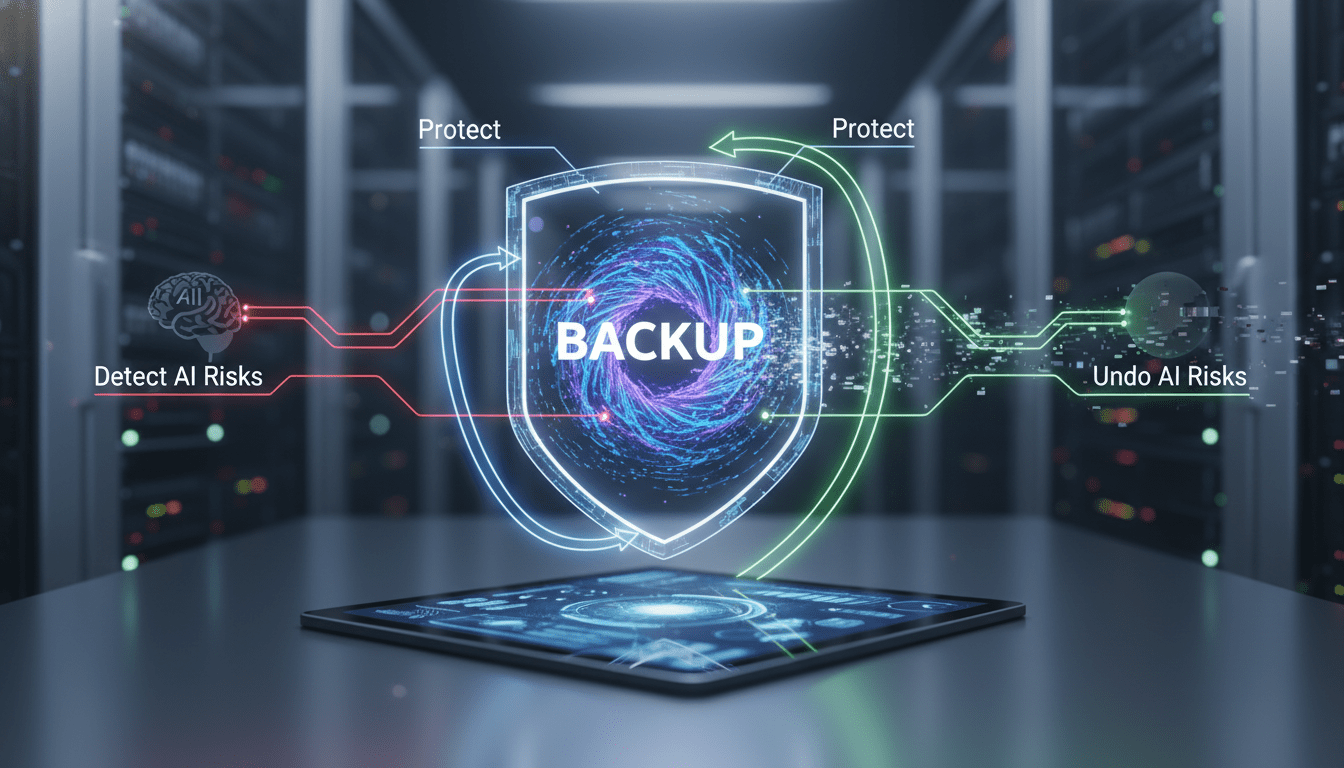
Agent Commander is built around three integrated capabilities: discovery and mapping of AI activity, runtime and data-layer controls, and targeted recovery workflows. Together they create a feedback loop: visibility informs policy enforcement, enforcement limits damage, and fast recovery reduces business disruption and risk appetite. For enterprises this shifts backup from a passive insurance policy into an active control plane for AI governance, where backups and observability are used proactively to prevent and mitigate incidents.
At its core, Agent Commander introduces a Data Command Graph that inventories interactions between agents, copilots, large language models, and the datasets they touch — whether those datasets live in production, cloud storage, or backups. It then layers automated classification, an LLM firewall for prompt and response monitoring, and file-level observability that enables surgical undos instead of full-volume restores.
How Agent Commander detects AI activity across an environment
Detection starts by addressing the “you can’t secure what you can’t see” problem. Agent Commander constructs a unified knowledge map of non-human identities and their actions across on-premises and cloud stores. That visibility solves several practical risks:
- It reveals shadow AI — experimental agents or developer prototypes left connected to production databases.
- It surfaces cross-agent interactions, for example a custom AWS agent that reads files in a SharePoint folder containing regulated data.
- It links agent activity to data sensitivity labels so governance teams can quickly assess compliance exposure.
Visibility is not just about listing agents; it’s about contextualizing interactions. Knowing which agent asked for which file, from which repository, and under what role or permission set is what turns raw telemetry into governable events.
Why runtime protection matters: data control and LLM firewalling
Detection is necessary but insufficient. Agent Commander couples observability with two protection layers:
- Data-level controls: Leveraging the Securiti classification engine, the platform can tag and enforce rules across hundreds of data sources. Sensitive files can be labeled HIPAA, GDPR-restricted, or business-critical, and those labels inform agent behavior — for example, preventing an agent from reading or using certain data in training or generation tasks.
- LLM firewalling: A new enforcement tier inspects prompts sent to agents and the responses returned. This protects against prompt injection, jailbreak attempts, and unintended behaviors (such as an agent that should handle customer support producing proprietary source code). The firewall can block or redact requests, apply response policies, and prevent agents from escalating privileges or initiating destructive actions.
Together these measures aim to turn ad-hoc agent interactions into policy-driven operations. Rather than trusting every agent and LLM implicitly, teams can apply rules that reflect legal, compliance, and business priorities.
Surgical recovery: why undo beats full restores
One of the most significant operational frictions with backups has been the bluntness of restores. When an automated process or agent corrupts data, standard practice has been to restore large volumes and spend hours or days reconciling changes. Agent Commander takes a different approach by offering file-level observability tied to agent actions, enabling precision recovery workflows:
- Surgical identification: The system can trace the exact files, database rows, or objects an agent modified or deleted, not just the volume in which the change occurred.
- Targeted undo: Administrators can roll back specific changes or files with a single operation rather than restoring entire datasets, dramatically reducing downtime and recovery complexity.
This precision reduces both the operational cost of incidents and the risk of incomplete or overbroad restores that themselves cause business disruption.
How Agent Commander changes the economics of security
Beyond risk reduction, Agent Commander reframes security from a pure cost center to a business-enabling investment. In practice, the tooling creates measurable efficiencies:
- Data hygiene and ROT removal: Visibility into redundant, obsolete, and trivial (ROT) data allows teams to delete petabytes of useless content, cutting storage and backup costs.
- Lowered cyber insurance exposure: Demonstrable reductions in attack surface and improved governance can translate into more favorable underwriting and premiums.
- Better AI outcomes: Clean, labeled, and current datasets minimize hallucinations and improve the performance of models that consume enterprise data.
These savings can offset the expense of the platform itself, creating a compelling return on investment for large data estates preparing for AI initiatives.
Who benefits and how deployment looks in practice
Agent Commander is relevant for a range of enterprise roles and environments. Security and privacy teams gain centralized visibility and policy controls; backup administrators are elevated to guardians of AI safety; platform and dev teams receive guardrails that let them iterate faster with less risk. Typical implementation steps include:
- Discovery and inventory: Initial scans to build the Data Command Graph and identify unmanaged agents and sensitive data locations.
- Classification and rule design: Applying labels and drafting policies that map to compliance needs and business logic.
- Runtime enforcement: Activating the LLM firewall and data controls for production agents.
- Recovery playbooks: Defining surgical rollback procedures and testing them through simulated incidents.
Organizations with large multi-cloud footprints, regulated industries, or heavy use of third-party copilots stand to see the strongest immediate benefits, but the design pattern is broadly applicable wherever agents or LLMs interact with sensitive information.
Technical building blocks: Data Command Graph, Securiti engine, and the LLM firewall
Agent Commander is not a single monolith but a coordinated set of components:
- Data Command Graph: A graph-based metadata layer that maps agents, identities, repositories, and assets. It supports queries like “which agents accessed EU resident records in the last 30 days?” or “which copilots have external API privileges?”
- Securiti classification engine: A data governance and labeling tier that identifies regulated content across hundreds of connectors and applies policies based on sensitivity.
- LLM firewall: A runtime inspection and enforcement layer that evaluates prompts and responses, prevents malicious or out-of-policy behavior, and enforces data usage restrictions.
When combined, these subsystems create a closed-loop where discovery informs policy, policy constrains runtime behavior, and observability enables precise response when violations occur.
Operational and developer implications
For engineering and platform teams, Agent Commander reframes several operational practices:
- Shift-left governance: Rather than retrofitting governance after deployment, teams can integrate labels and rules into CI/CD pipelines so agents are constrained before they touch production.
- Observability-driven incident response: Engineers will need to instrument agents and workflows so the Data Command Graph can correlate events across systems.
- Changes to access models: Fine-grained permissions and ephemeral credentials will gain prominence as the best way to limit an agent’s blast radius.
For developer tooling, expect closer coupling between model orchestration platforms, secrets management, and backup/restore primitives. Integration points with MLOps pipelines and feature stores will become increasingly important as teams seek both agility and safety.
Regulatory and compliance considerations
Agent Commander’s model of labeling and preventing access to regulated data directly addresses compliance concerns such as GDPR, HIPAA, and other regional privacy laws. By mapping agent actions to data classifications, auditors can produce clearer records showing where data was accessed, by which non-human identity, and what controls prevented misuse. This is particularly valuable where agents act with delegated human permissions and could otherwise create complex chains of liability.
However, governance teams should be mindful that tooling alone does not guarantee compliance — policies must be well-crafted, and enforcement needs periodic testing. Organizations should pair Agent Commander with policy reviews, privacy impact assessments, and regular tabletop exercises to validate response plans.
How Agent Commander fits into the broader vendor landscape
Veeam’s move is emblematic of a larger industry trend where backup vendors, storage providers, and security firms broaden into AI governance and data management. As generative AI matures, adjacent categories — data protection, data governance, MLOps, and security — are converging. Vendors that historically focused on storage or backups are repositioning their products as data platforms that enable safe AI use cases.
This shift raises competitive and partnership questions. Some vendors will extend existing backup and classification capabilities with AI-centric controls; others will integrate with model governance platforms, identity providers, and cloud-native orchestration tools. For enterprises, the result promises a richer set of choices but also a higher integration burden: selecting vendors that play well with your cloud, CI/CD, and identity stack becomes as important as their feature lists.
Practical questions enterprises will ask — and how Agent Commander addresses them
Enterprises evaluating this class of product typically want to know what it does, how it works, why it matters, who should use it, and when it’s ready for production. In practice:
- What it does: It discovers agent activity, labels and protects sensitive data, and enables precision recovery of agent-caused changes.
- How it works: By ingesting metadata and telemetry across data sources, applying automated classification, enforcing runtime policies via an LLM firewall, and tying agent actions to file-level versioning for surgical undo operations.
- Why it matters: It reduces the technical and regulatory risk of agentic AI while improving operational efficiency and lowering storage and insurance costs.
- Who can use it: Security teams, backup administrators, platform engineers, and privacy officers — particularly in organizations with multi-cloud estates or regulated data.
- When to deploy: As soon as an organization has agents or LLMs interacting with production or sensitive data; early deployments often begin in high-risk slices of the estate (e.g., HR, finance, customer data) before broader rollout.
These capabilities shift the conversation from whether to run AI agents to how safely and responsibly an organization can do so.
Broader implications for the software industry, developers, and businesses
The convergence of backup, governance, and runtime controls signals a redefinition of data protection. For the software industry, this means product roadmaps and go-to-market motions will increasingly emphasize integration with AI governance ecosystems: model registries, MLOps pipelines, identity platforms, and regulatory reporting tools. Developers will be asked to embed data classification metadata into applications and to design agents that respect runtime policy signals — a change that nudges engineering practices toward privacy-aware design.
For businesses, the most immediate effect is strategic: companies that can safely scale agentic automation may achieve faster operational gains, while those that cannot will risk falling behind. This bifurcation creates incentive for investment in platforms that provide both preventive controls and fast remediation. It also reshapes hiring and skills: backup administrators who can operate the new control plane — blending observability, policy, and AI governance — become key players in digital transformation.
Risks, limitations, and things to watch
No single product can erase all risk. Agent Commander reduces exposure but also introduces new operational dependencies: the accuracy of classification engines, completeness of discovery connectors, and correctness of policy definitions become critical points of failure. Organizations must maintain rigorous validation of labels, continuous monitoring of the LLM firewall for false positives and negatives, and robust testing of recovery flows. Additionally, integrating these controls across legacy systems, third-party SaaS, and ephemeral cloud-native infrastructure will require careful engineering.
Finally, as regulatory frameworks evolve around AI and data use, vendors and customers alike will need to adapt functionality and controls to meet new legal expectations.
The rise of precision data resilience reframes how enterprises approach AI: protection, observability, and rollback become first-class features rather than afterthoughts. Tools that unite these capabilities — such as Veeam Agent Commander — lower the operational barriers to deploying autonomous agents safely, while also changing the role of backup from insurance to active governance. Over the next several quarters expect tighter integration between backup platforms, model governance tooling, MLOps pipelines, and identity systems, along with stronger emphasis on data hygiene as a business priority.
As enterprises experiment and scale with agentic AI, future developments will likely include richer integrations with model registries and feature stores, automated policy synthesis from regulatory requirements, and more advanced anomaly detection that links subtle model drift to potential data misuse. The companies that stitch together detection, runtime controls, and surgical recovery will set the operational baseline for safe AI adoption, enabling organizations to accelerate innovation without sacrificing control.